
A full detailing of my experience including costs, transportation, and more.
Iceland had always been one of my dream destinations, but with it being such an expensive country, visiting always seemed unrealistic.
However, earlier this year I took a trip to the UK with my family. I decided to leave a week earlier than them to explore England before meeting them in Scotland, and that meant I’d have to find my own plane ticket. Upon scouring Google for the cheapest ticket, I found that Icelandair offered a decent round-trip price, and going through the airline would also allow you to do a “Stopover in Iceland” for a few days without any extra plane fees. So basically, I’d be able to fly to Iceland for the same price as the round-trip ticket to the UK I was already paying for (which cost $1,375 from Chicago after fees and taxes). With the plane expense taken care of, I decided to take the opportunity to spend two nights in Iceland.
You have the option to do your Iceland stopover on the way to your initial destination or on your way back home, and I chose to visit at the end of my trip. You can do a stopover for up to 7 days, however due to expenses I just spent two nights there. I really just wanted to see the main sights along the southern coast and at least be able to say I’d been to Iceland until I can afford a full trip around the country.
Price Breakdown
Without the plane expense, my short trip in Iceland cost me about $500. If I had done a week-long trip, I would’ve paid $2,000+ for lodging, food, and either renting a car or joining a tour.
Here is a brief breakdown of my expenses:
- Lodging (2 nights at Kex Hostel): 24.654 ISK = ~$180
- Tour: $102
- Bus to Reykjavík: 4.999 ISK = ~$36
- Bus to airport: 4.999 ISK = ~$36
- Food: ~$100
- Souvenirs: ~$25
Total: ~$480
Initially, I debated renting a car from the airport for 24 hours. Since I was visiting just a week after the summer solstice, there was going to be 24-hour daylight. I wanted to use that to my advantage and explore the country as much as I could with the little time I had. However, the cheapest car I could find was over $250 and it was manual transmission, which I am not familiar with driving. It was cheaper and easier to take the bus into Reykjavík and join a day tour, which cost about $175 total.
Day 1: Arrival

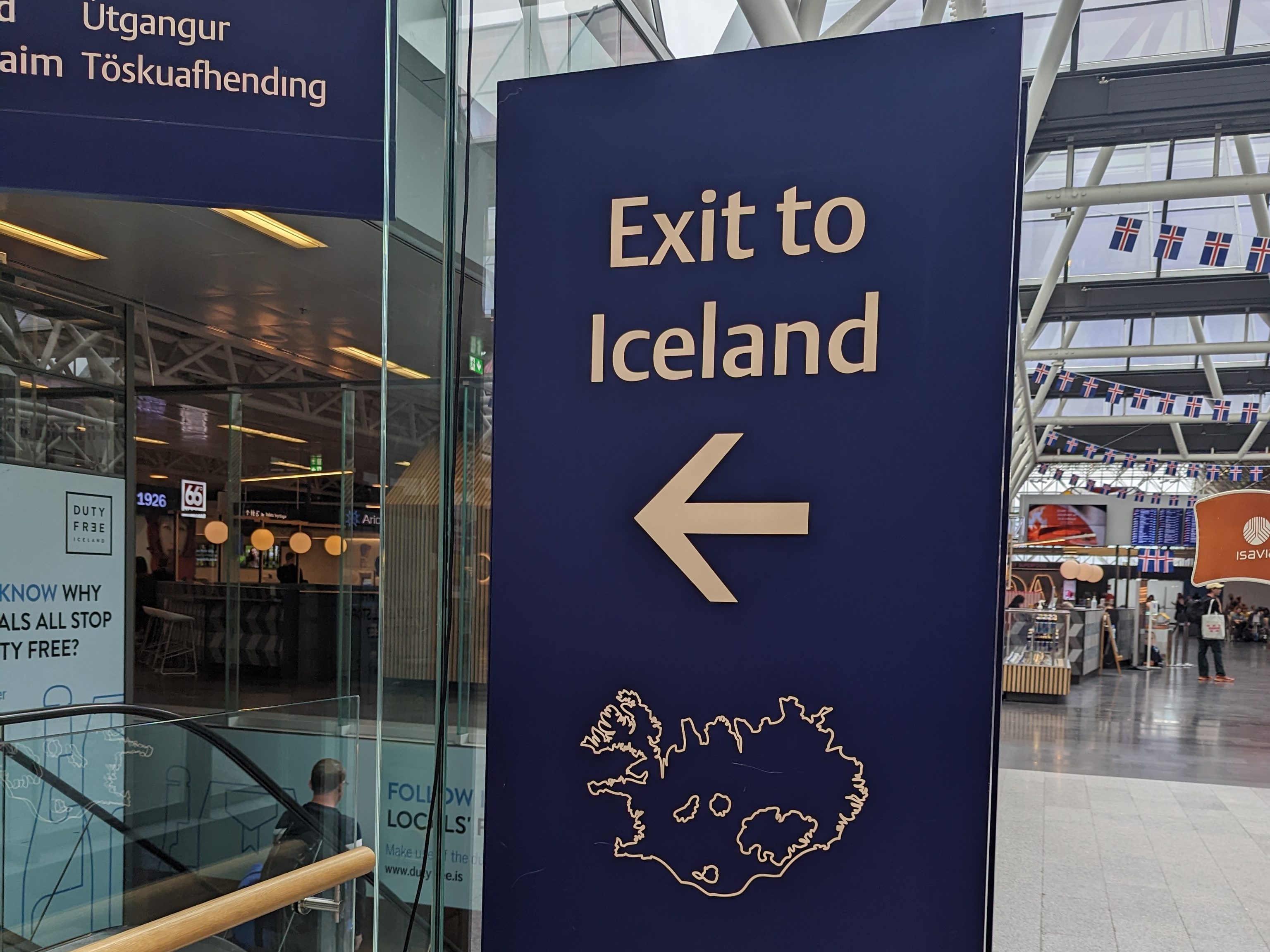
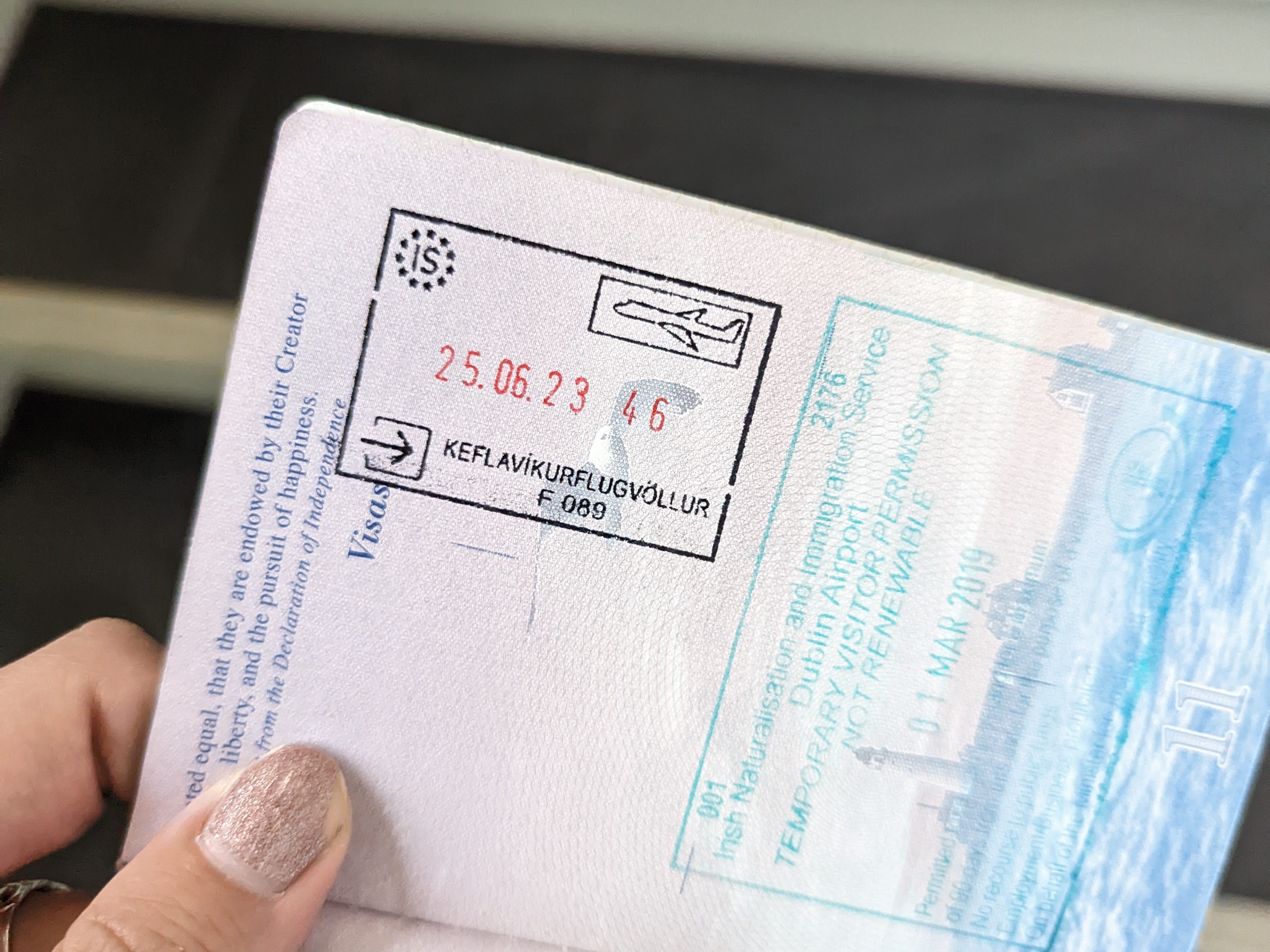
I landed at Keflavík Airport at around 4 p.m., and to get from the plane to the arrivals building we had to go outside and take a small shuttle. Upon stepping outside, I was greeted with crisp, rainy air.
Two weeks prior to this visit, I had been in London where it was 80+ degrees most of the time, then in Scotland where it was 60-70. The temperature in Iceland was 45 degrees when I arrived and stayed around 45-55 the entire trip. It was quite a difference. Thankfully I knew it would be chilly and came prepared, vacuum sealing a thick winter/raincoat in my luggage until my flight to Iceland.
When planning the trip, I knew I had to find a jacket that was warm and waterproof, and many people warned online about getting a cheap coat. Well, I didn’t have money for a $200+ coat, so I settled on a ski jacket from Wantdo for under $60 (not sponsored, I don’t have enough readers for that haha). While the quality of the stitching isn’t the best, the jacket kept me completely warm and dry. I got poured on a few times, so it was definitely put through some tests.
I also bought rain pants for the trip, but I never wore them because I was on a bus for the majority of the time it was raining on my day tour. The only time I really could’ve used rain pants during my brief trip was at the waterfalls because of the mist, but my pants surprisingly dried pretty quickly. Though, I didn’t pay much attention to the water anyways because I was overwhelmed with pure joy and happiness. More on that later.
Getting to Reykjavík from the Airport
Once I acquired my suitcase, I headed back outside to get the bus into Reykjavík.
I ordered Flybus Airport Transfer tickets ahead of time through Reykjavík Excursions which were about $36 for a one-way trip, so $72 both ways. While expensive, this was the cheapest way to get to and from the airport, considering Reykjavík is a 45-minute drive away. The busses leave every 35-50 minutes from outside the arrivals exit and operate 24/7. In addition, the busses will take you right to your accommodation. You just have to note your destination when you book your ticket.
The drive was a nice and cozy way to be introduced to the rainy Icelandic landscape while in a tired state from travelling. Before being taken to my hostel, we had to stop at the bus terminal in Reykjavík to transfer to a local bus. From there we headed into downtown Reykjavík where we were dropped off at our respective lodgings. I booked a bed at Kex Hostel and was dropped off right in front of the building.
You also have the option to take the Flybus to the Blue Lagoon before heading to Reykjavík, but it was too pricey for me this trip (the cheapest ticket for the time I would’ve been there was over $100).
Kex Hostel

Upon arrival to the hostel at around 6 p.m., I was able to check in and freshen up a little bit. The flight from Scotland was not very long (less than 3 hours) and Iceland’s time zone is only an hour behind Scotland’s, so I didn’t have to worry about a huge time adjustment. So, I briefly organized my bed and belongings before heading outside to explore Reykjavík for the first time and find some dinner.
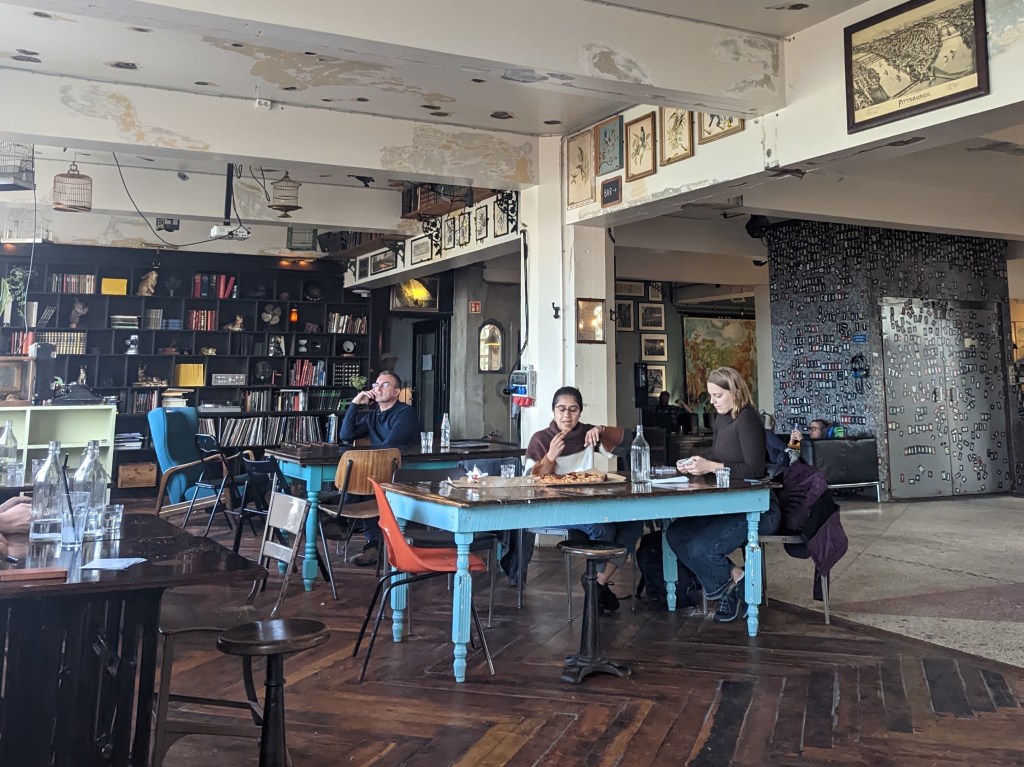
Kex Hostel is very rustic, but I really enjoyed the vibe. The only issues I had were that our door was incredibly squeaky (I felt terrible every time I went in and out of the room while people were resting) and the bunks were made of metal and were squeaky as well. I also had a roommate who was talking and laughing on the phone in the middle of the night, but of course that’s nothing the hostel could control.
Read More: 4 Tips on How to Choose a Hostel
The rooms also had blackout curtains on the windows, which I was grateful for because it was summer and Iceland is just south of the Arctic Circle, which means there was 24-hour daylight. More on that later as well.
First Impressions of Reykjavík
When I stepped outside of my hostel, I started uncontrollably smiling. It was still pouring rain, but the air was so fresh and the city was so quiet—it was beautiful. I could faintly see the bay across the road from me, and the atmosphere felt so fresh and clean and magical. I know I already said fresh, but it truly felt so new and so fresh.
As I started walking around, I noticed the simplistic, colorful architecture of the buildings for the first time. The design of the structures is very different from the architecture in most of America/Chicago (where I live). Reykjavík also isn’t a very big city and there are no towering high-rises blocking the sky, which is extremely refreshing.
I was trying to find a specific road that was supposedly lined with shops, but I ended up wandering in the wrong direction. Though, I didn’t mind the detour even though I was being drenched in buckets of rain (again, I really put that coat to the test). I was just happy to be exploring in the calm city. Despite it being the biggest city in Iceland, there weren’t hoards of tourists crowding the sidewalks. Again, is was incredibly refreshing (okay I swear I’m done saying “fresh” now).
I eventually found my way to the road I was looking for and stopped in a few souvenir shops to acquire my obligatory souvenir keychain. I’ve been collecting keychains in every country I’ve solo travelled, so this was a necessity to keep the collection going. After I found my typical touristy momento, I perused a few other stores. I saw other popular souvenirs included lava rock jewelry and a specific type of Icelandic wool sweater called a lopapeysa. Though, those were $200+ each, but perhaps I’ll purchase one another time when I don’t have a limited budget.

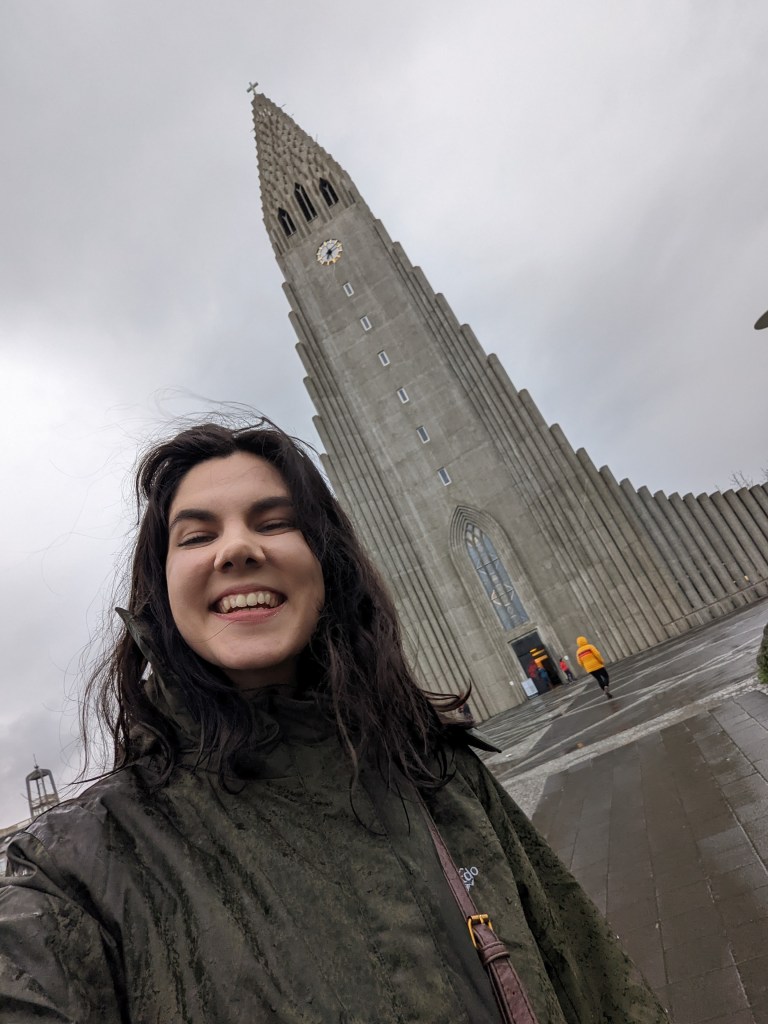
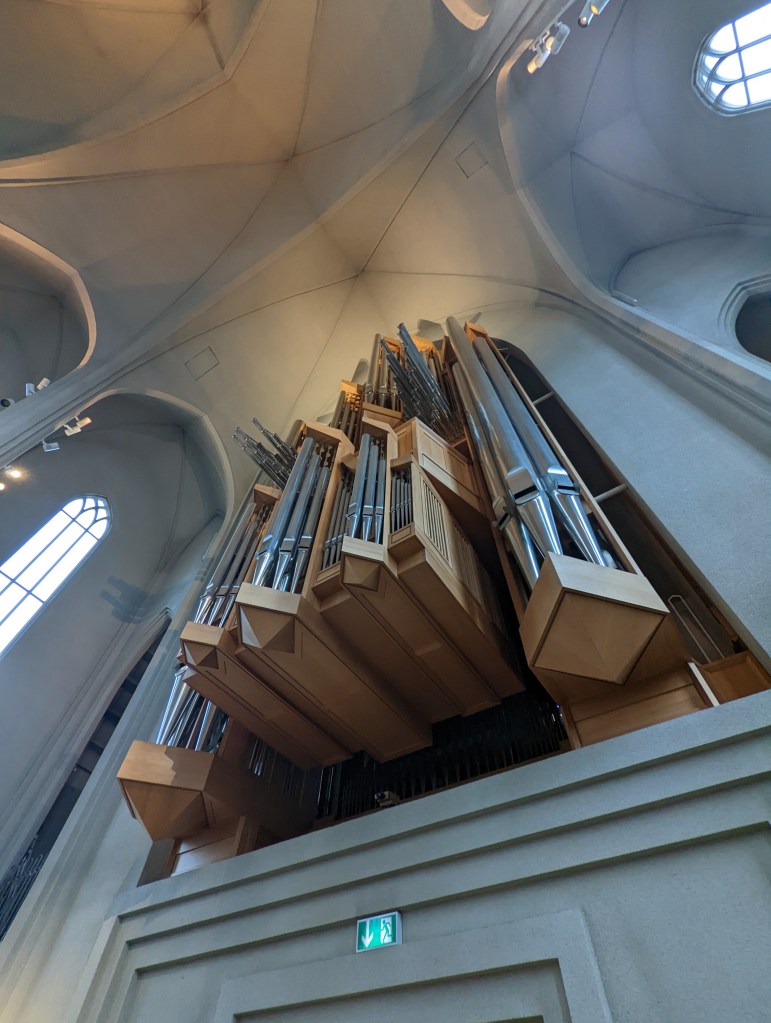
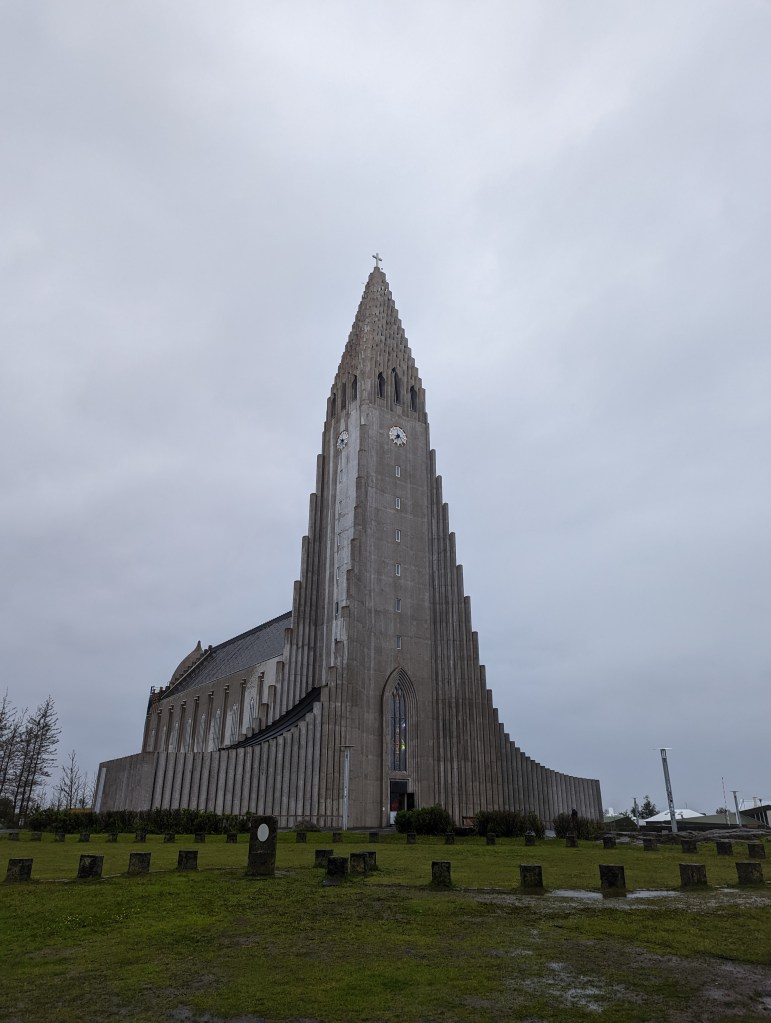
I happened upon the iconic Rainbow Street which leads up towards the famous landmark Hallgrimskirkja (which means the Church of Halgrimur). Built in 1986, this concrete and granite structure is relatively new and reflects Iceland’s simplistic architectural style while connecting it with the country’s natural elements—specifically basalt columns. I stopped by the church and admired its external architecture as well as the unique pipe organ inside. Though, I was really surprised to see the inside of the church looked quite mundane. I suppose it was an unfair comparison considering I’d visited some very old and elaborate cathedrals while in the UK.



Before heading back to the hostel, I walked through a few convenience stores to find a “cheap” dinner. Also, when I checked into the hostel and went to charge my phone for a few minutes, I realized the plug adapter I had didn’t fit into the sockets, so I had to search for a new adapter. After looking through a few stores, I eventually found one along with a sandwich for about $15. As I mentioned earlier, the main reason I only stayed in Iceland for a couple days was because of the cost—particularly for accommodations, transportation, and food. To give you a little more insight into how much food typically is there, a salad next to the sandwich I bought was $17.
I had one more necessary stop prior to going back to the hostel: Bónus. Bónus is the main supermarket in Iceland and it’s known for its adorably funny-looking pig mascot, so of course I had to stop in there and look around. I ended up getting some sweet snacks to save for when I got home, but I found these chocolatey granola bites that I snacked on throughout the next 24 hours and became addicted, so I got another bag before I left the country. Wow I miss those (though I can’t remember the name of them for the life of me).
While doing research for the trip, I had heard that people in Iceland don’t generally do small talk, which was a big relief to me as someone who doesn’t like social interactions with strangers. And, it turned out to be true. There was no “hi how are you” when I checked out at the register. I don’t even think they told me my total. I just paid, grabbed my things, and left. An anxious introvert’s dream.
After I finished wandering, I ate my sandwich on a couch in the hostel lobby, which was also partially a bar. I then moved to a table in the corner of the room to edit photos and anxiously scan the room to see if there was anyone I could interact with. A lot of people at the other tables seemed to be travelling in groups and I didn’t want to interject, so I ended up just ordering myself a cider (that was nearly $12 oof) and continued editing. Eventually I headed up to my room around 8:30 and settled in for the night.
I had wanted to explore the city more in the evening/night because it was still light outside, but the weather was still pretty dreary and I was tired from travelling. So, I opted for an early bedtime to rest up for the big day trip ahead.
I’m not sure exactly what time I fell asleep, but I woke up a few times throughout the night. My bed was right by the window and the blackout curtain was left slightly open, and I briefly woke up at 1 a.m. to confirm that, despite it still being heavily overcast, it was indeed still light outside.

Day 2: Trip to the South Coast
Trip Overview
The next morning, I woke up around 7 and got ready for the day. I was sure to layer up as I’d heard Iceland weather is unpredictable and I wanted to ensure I’d stay warm and comfortable the full 8+ hours.
The tour I booked was through BusTravel Iceland, though I found it on Get Your Guide. Specifically, it was the “South of Iceland Full-Day Trip from Reykjavík”, which stopped at the main sights along the southern coast:
- Skógafoss (waterfall)
- Sólheimajökull Glacier
- The village of Vík
- Reynisfjara Beach and the basalt columns/black sand
- Seljalandsfoss (waterfall)
The other tour I was interested in taking was around the famed Golden Circle, which is the most common tourist route. However, I really wanted to see Skógafoss and the black sand beaches. If I had another day, I would’ve visited the Golden Circle as well.
This particular day was a stark contrast to the weather the day before. As soon as I stepped outside, I was smiling uncontrollably once again, this time because the sun was shining and the clear blue sky reflected on the bay, which I didn’t realize was surrounded by mountains. The rain and mist the day before obscured the landscape in the distance, but today the horizon was much clearer.

After soaking up the sight, I walked a short 10-minutes to the meeting location for the tour. There were a couple busses already parked there along with a few other wandering tourists who looked as confused and clueless as I was trying to figure out where the correct bus was. Turns out, there were multiple tours meeting at this spot and none of our busses were there yet. My bus didn’t actually arrive until about 20 minutes past the original meeting time.
Once we were picked up, we had to stop at the bus terminal (the same one we stopped at after the airport) so a few people could transfer to smaller tours, and then we were finally on our way. Our guide and driver—whose names I can unfortunately no longer remember—were both amazing.
The Landscape: Initial Thoughts

I’m going to sound really annoying repeating myself throughout this entire post, but I could not (and still cannot) get over how absolutely stunning Iceland is. Words cannot accurately describe how breathtakingly beautiful this place is, but at least I have photos to help. Still, nothing compares to the real thing.
As we started driving, the landscape was incredibly dark and covered in a thin layer of lush green vegetation. It was such a unique landscape compared to anything I’d seen before. The prettiest countries I’d been to prior were Ireland with its rolling green hills and stunning sea cliffs as well as Italy with its mountainous countryside, but Iceland’s landscape is incredibly dramatic. On one side of the bus were endless mountains and valleys, and on the other were flat, wide open green fields. Among the mountains were hundreds of waterfalls cascading down sharp cliff sides. The scene was indescribable: the rise and fall of the rugged landscape combined with the deep colors of the dark volcanic pastures and rainy haze was unbelievably picturesque. I know it sounds like I just described it there, but again, words just won’t cut it. Even pictures don’t capture the sheer beauty of it all.

At one point we were overlooking a small town beside a mountain, and we could see natural steam coming from multiple points in the terrain. It almost looked like white smoke billowing from chimneys. Our guide mentioned how she was so used to seeing the steam growing up, but when she started guiding she realized people don’t see things like that on a daily basis, if at all. She had taken for granted how unique and incredible Iceland’s natural wonders are until she saw Iceland through the eyes of her guests. These natural vents were really neat to see.


After driving for about an hour and a half, we stopped at a small gas station for a quick snack and break before continuing on our journey. As we drove by some steep mountains, the weather suddenly changed drastically. What had previously been calm, clear blue skies turned into a dark cloudy haze with ferocious winds and buckets of rain. Apparently, this isn’t an uncommon occurrence. In fact, there are warning signs set up along the road in areas where winds and bad weather tend to be because of the position of the mountains.
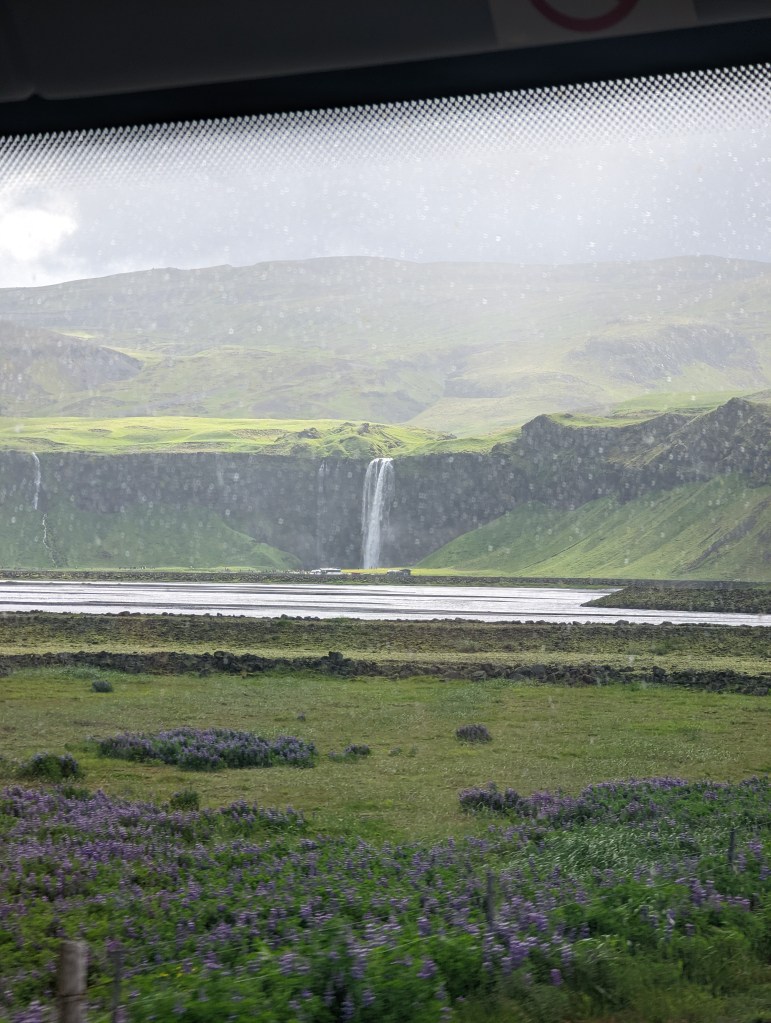
On the way we also briefly passed by Seljalandsfoss, which is a stunning waterfall we stopped at on the way back to Reykjavík. It was neat to get a sneak peek of it even though it didn’t look like much from afar, but it ended up being one of my favorite stops. More on that later.
First stop: Skógafoss

Out of everything there is to see in Iceland, the #1 thing I wanted to see was Skógafoss. I’m not sure why, but it was. And it just so happened to be our first official stop.
Before we approached the waterfall in the bus, our guide told us to look to the left. For a moment, all we could see was a rocky cliff beside us. Then she counted down. 3. 2. 1.
In that instant, we passed the edge of the mountain and Skógafoss came into view. I audibly gasped at our guide’s perfect timing and how beautiful the waterfall was. And we weren’t even that close to it yet.
We officially arrived at Skógafoss at 11 a.m. and our guide gave us about 30 minutes there, which might seem like plenty of time to look at a waterfall, but it goes by very quickly if you like to take lots of photos and also want time to take the moment in. Luckily, once the bus was parked, it only took a couple minutes to walk from the parking lot up to the waterfall. And, to our luck, it stopped raining by the time we parked and remained clear for the rest of our trip.

Again, Skógafoss was the #1 thing I wanted to see in Iceland. I’d say it lived up to the hype, minus the crowd of other tourists, all adorned in their brightly colored rain jackets. Though, even then it wasn’t nearly as crowded as places I’d been to a week prior in England (*cough* Stonehenge *cough*).
The roar of the thick band of water cascading over the cliff side was oddly comforting—a natural white noise. The sight itself was breathtaking. You don’t really realize how immense something is until you’re standing right in front of it.
You can’t get very close to the waterfall because it feeds into a small river, but you can still get drenched from the showers of mist from the base of the falls. This was one instance where my rain pants would’ve come in handy, but I hardly noticed how damp my clothes were getting under the time constraints and the awe I felt.
To the right of the waterfall, there’s a stairway that allows you to see Skógafoss from the top of the cliff that takes about 15 minutes to climb. I’d already spent about 15 minutes at the base of the waterfall and debated hiking up the stairs. I eventually convinced myself to go, because when was I gonna have the chance to visit Skógafoss again? I thought: I might as well go while I’m here.

So, I went. Keep in mind, it was said to take about 15 minutes to walk to the top, and I only had 15 minutes until I had to be back on the bus. I honestly don’t know if I’ve ever climbed so many stairs in a row, and I was booking it. After climbing 527 steps and getting the best leg workout of my life (surprisingly, my legs didn’t hurt at all the next day), I managed to get to the top of the slope in about 10 minutes. That gave me a couple minutes to take in the view.
From the viewing platform, you can’t really see the full waterfall. Rather, you can see a small portion of the Skógá River as it nears the edge of the cliff along with an endless expanse of rolling hills beyond. Though, you do get a gorgeous view of the flat land below. I don’t know if I’d consider climbing to the top of the stairs worth it if you only have 30 minutes at the waterfall, but I’m still glad I went.

After taking a few photos and videos, I had about 5 minutes to get back to the bus. So, thus began my hasty descent. I ran down those steps as fast (and as carefully) as I could, swiftly passing by people who had time to take their time. And—you might be surprised to know—I made it back to the bus right on time. I made that 20-25-minute trek in under 15 minutes. That’s probably not very impressive, but I’m not a very athletic person.
And then, it was on to the next stop.
Stop #2: Sólheimajökull Glacier
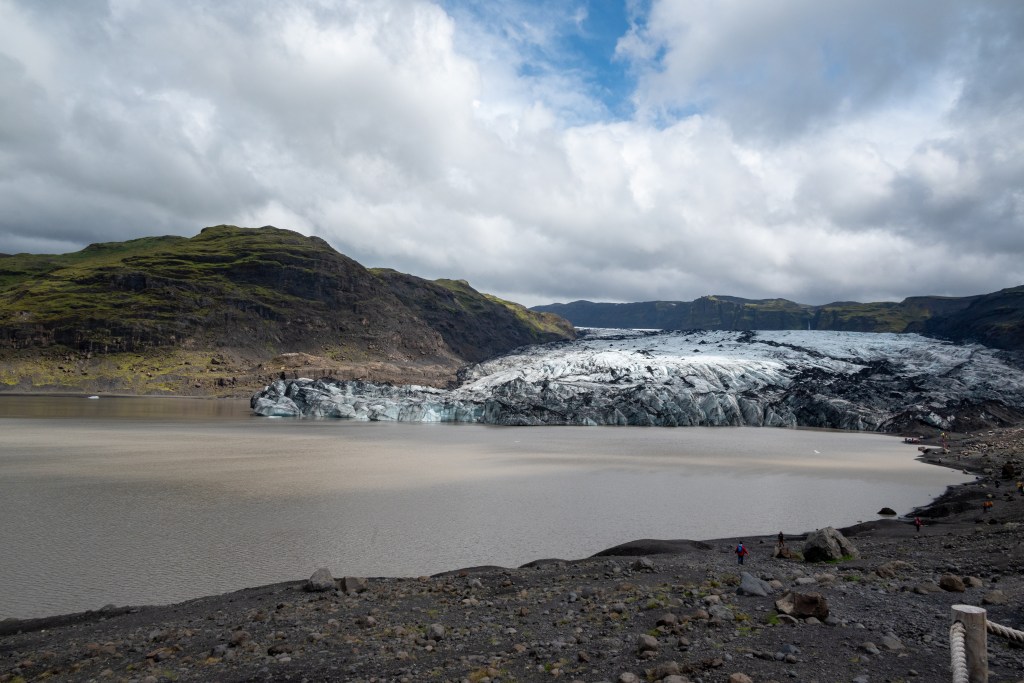
About 20 minutes later we arrived at our second stop of the day: Sólheimajökull. This is an outlet glacier that’s about 11 km long, though it’s slowly shrinking and melting away, forming a lagoon where the rest of the glacier once was. The name means the “home of the sun glacier” and it’s the 4th largest glacier in Iceland (out of 269).
Once we arrived in the parking lot, it took about 10 minutes to walk to the glacier viewpoint. We were surrounded by dark green hills and small streams of waterfalls as we walked in the valley.
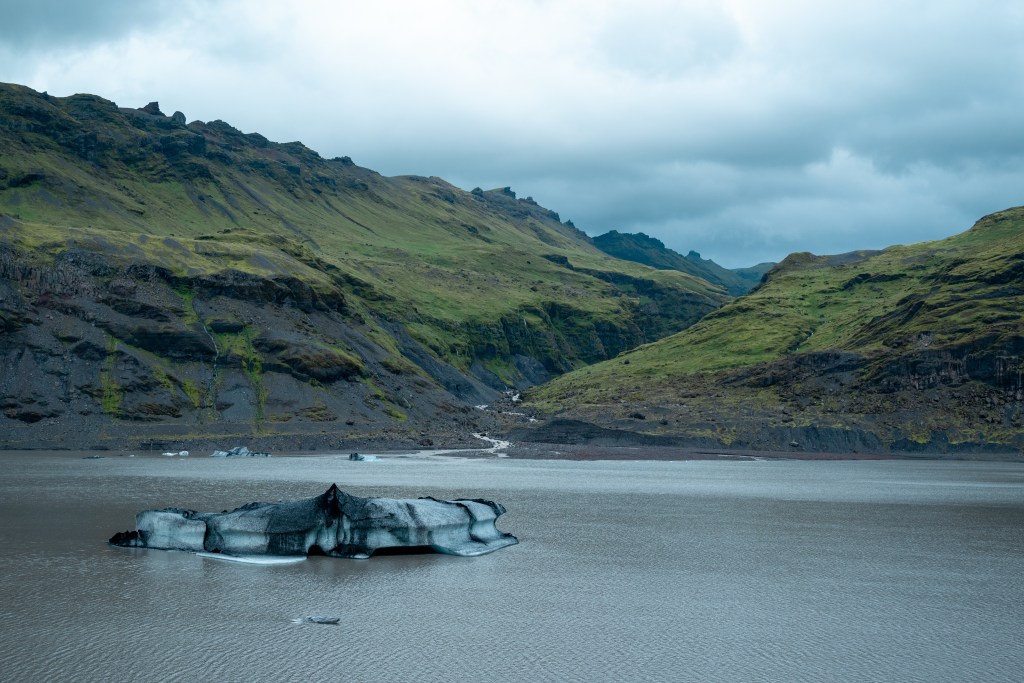
A couple minutes in, the main sight came into view: among the mountainous slopes was the receding glacier, its light blue hues turning to ashen black as the ice melts and reveals the sediment it picked up years and years ago. A murky brown body of water sat at its base with smaller chunks of glacier ice peppered throughout.


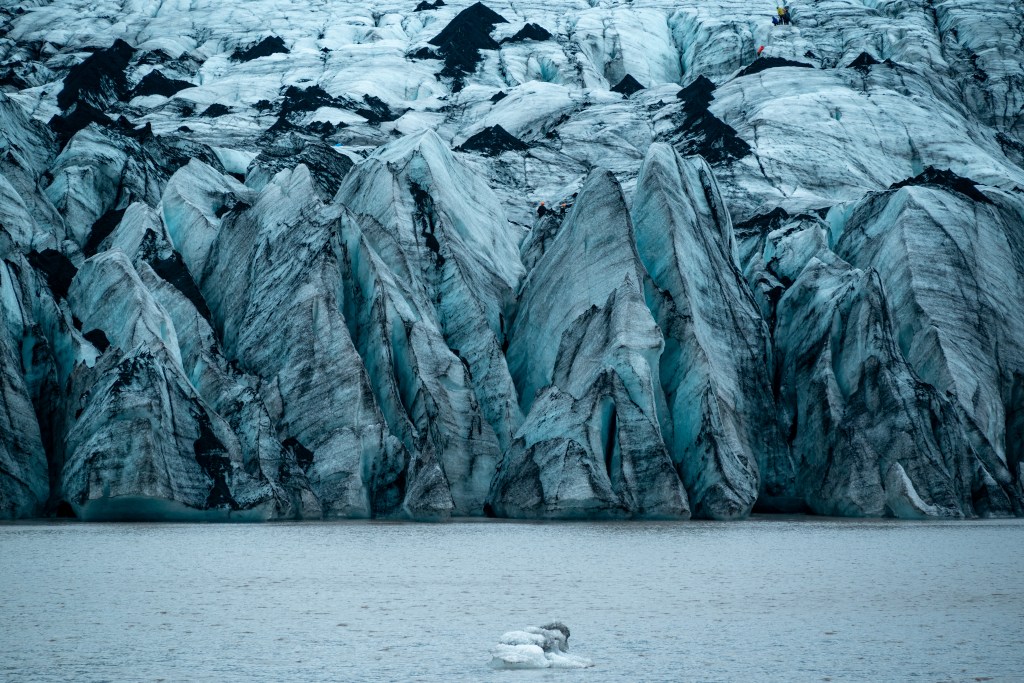
Our guide warned us about getting too close—with the glacier melting, ice collapses have become more unpredictable. So, we stayed behind a specific point, but I was still able to get some really neat close-up photos.
You are actually able to walk on the glacier, but only if you’re with a trained expert on a tour. This is because of a few reasons:
- The ice is slippery, so you need proper gear and
- Again, the ice is melting. New caverns are emerging and it’s becoming difficult to know where they are forming. In fact, they predict that they won’t be able to do glacier walk tours anymore within the next 5 years. I felt very lucky just having the chance to see this glacier while it’s still here.

Similar to my experience at Skógafoss, I didn’t realize how big the glacier was until I saw how tiny the people walking on the glacier looked. They were colorful little dots, almost like sprinkles on ice cream.
We spent about 30 minutes here, which was plenty of time to walk to the glacier and back and spend about 10 minutes taking in the view.
Then, we carried on throughout the mountainous green landscape to…
Stop #3: Vík
By the time we arrived in the remote village of Vík, it was nearing 1:30 p.m. Aka, time for lunch.
There was a small building with a couple shops and cafes, so before I did any exploring I grabbed a sandwich there and ate it quickly. We had less than an hour here and I wanted to see some of this famed seaside town. After finishing my meal, I headed back outside.
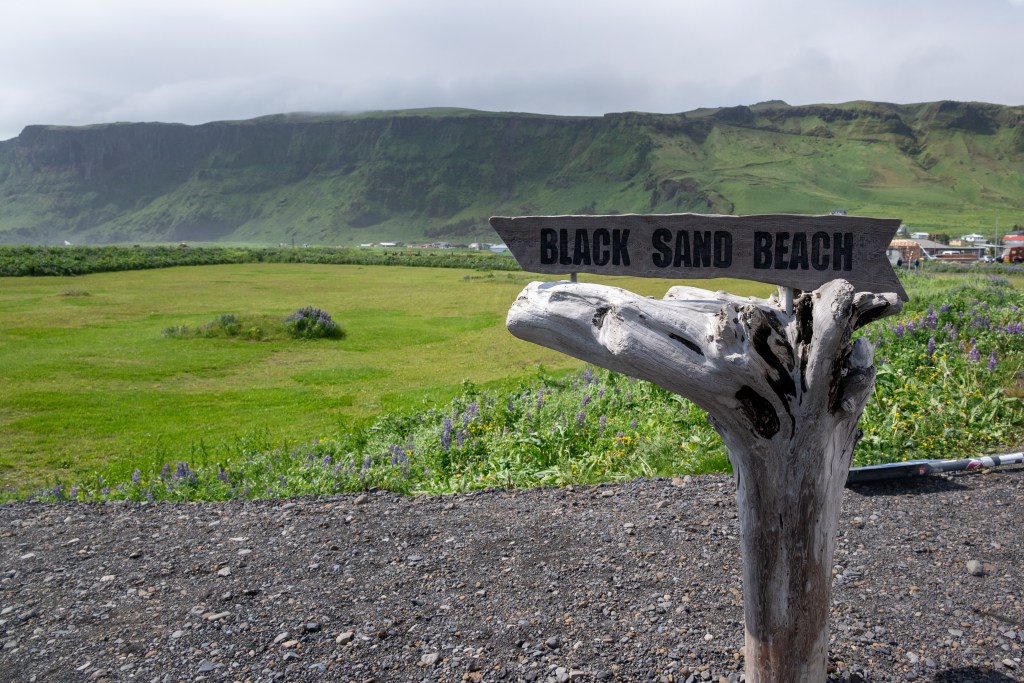
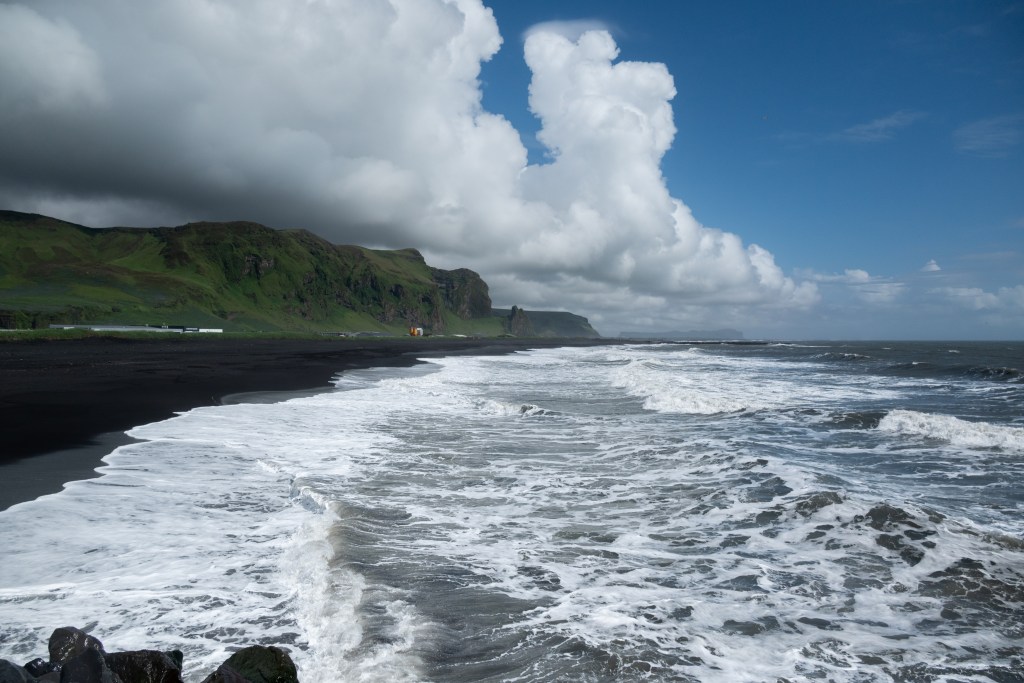
The southern coast of Iceland is lined with black sand beaches. We visited the most famous black sand beach after Vík, but there’s a gorgeous one in the village as well. So, that’s where I went.
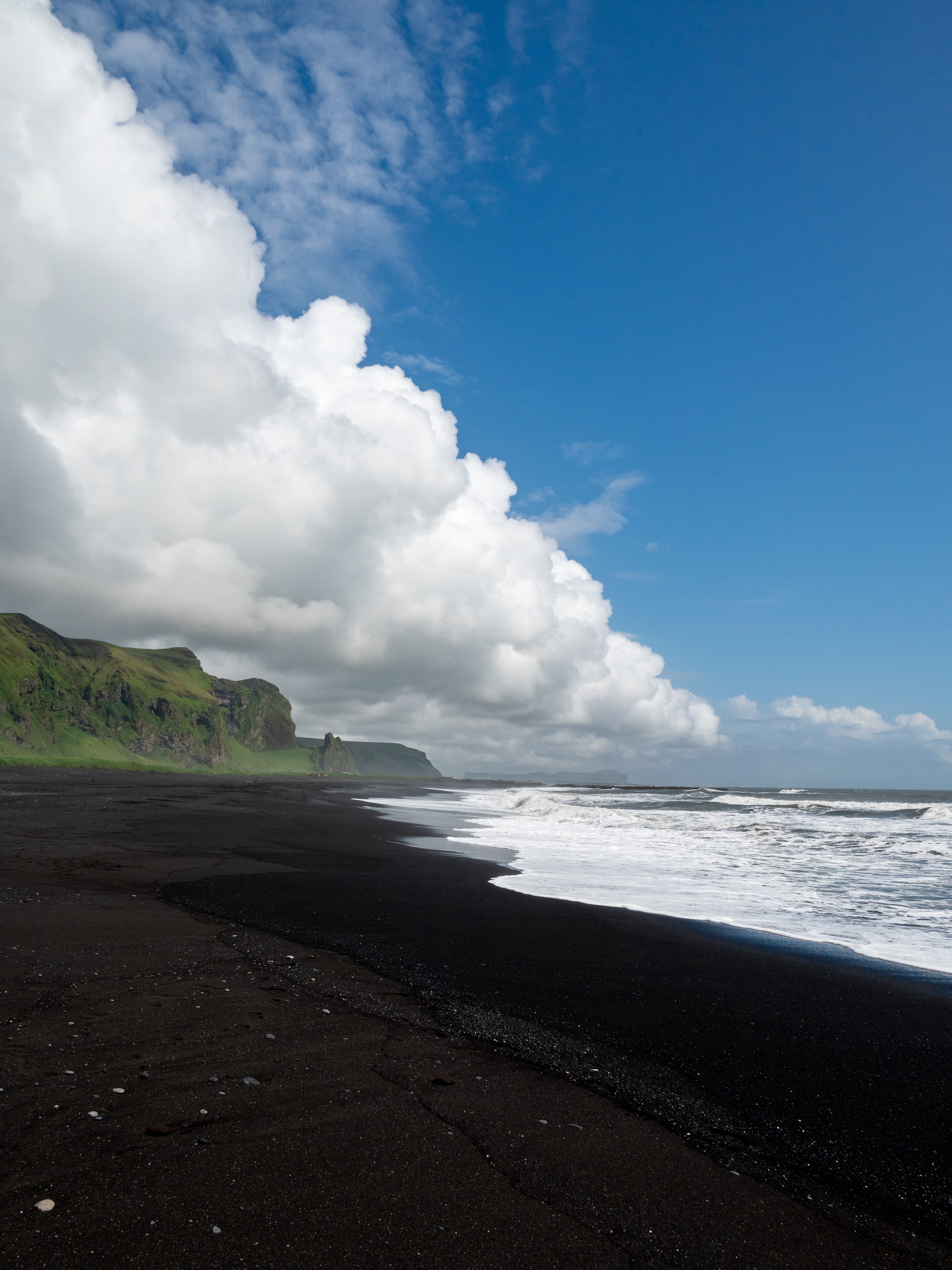
Much like a lot of Iceland’s landscape, black sand is made up of volcanic material. One thing that makes Iceland so stunning is the contrast and saturation of its colors, primarily thanks to the volcanic minerals. The dark sand made the already unbelievably lush green hues coating the mountains pop even more, and the green contrasted against the azure sky and voluminous white clouds. And that’s not to mention how the black sand made the foamy white sea even brighter.

I stayed pretty far back from the churning ocean waves, but it was incredible to watch as the massive swells caught the sunlight as they flowed towards the shore. You’re not allowed to swim anywhere along here because of the dangerously strong currents. More on that a little later.
I spent a lot of time taking photos and just admiring the view. I don’t think my words can describe the sights any better at this point than these images:
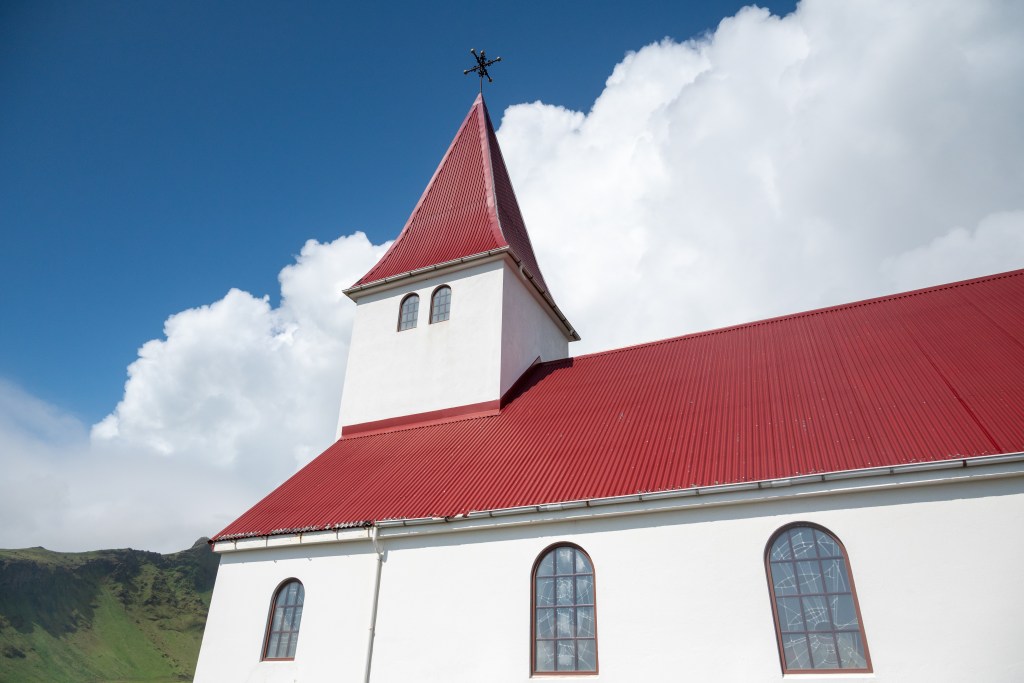
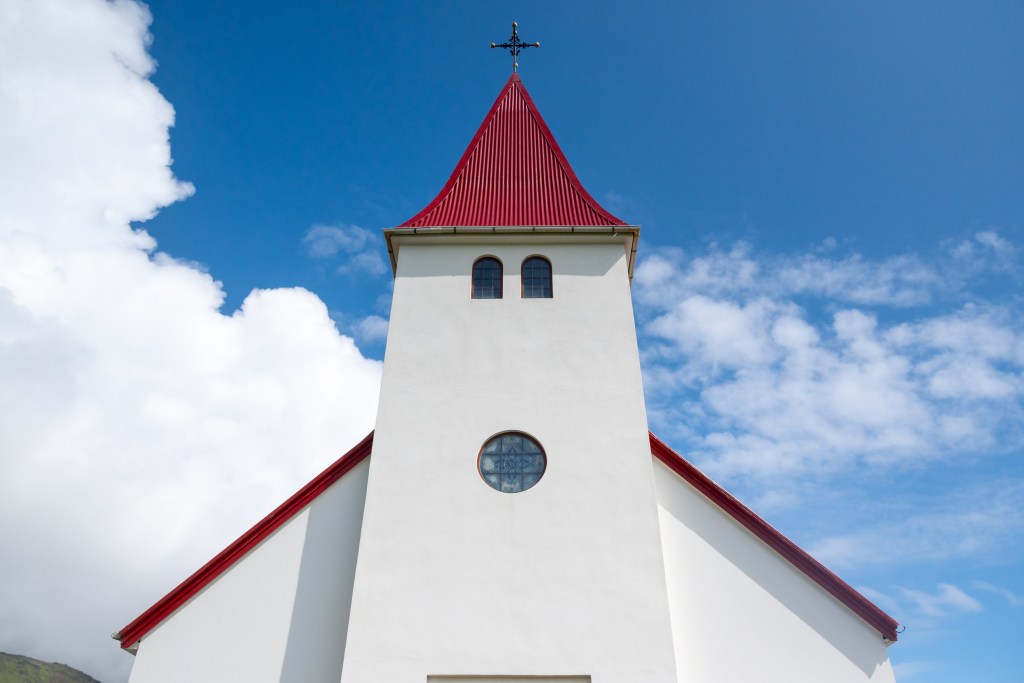
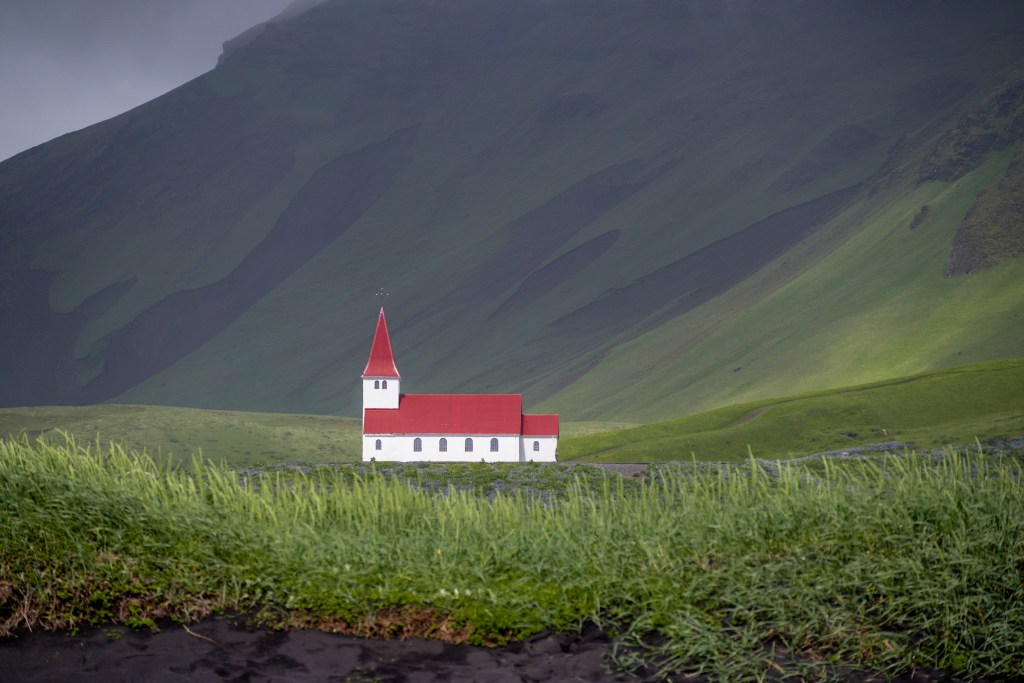
Once we got back on the bus by the building, they took us up the hill to Reyniskirkja Church—a popular small white church with a bright red roof in Vík. We were able to see the church from a distance on the beach, but now we had a wonderful close-up perspective as well as breathtaking views of the city and ocean below.
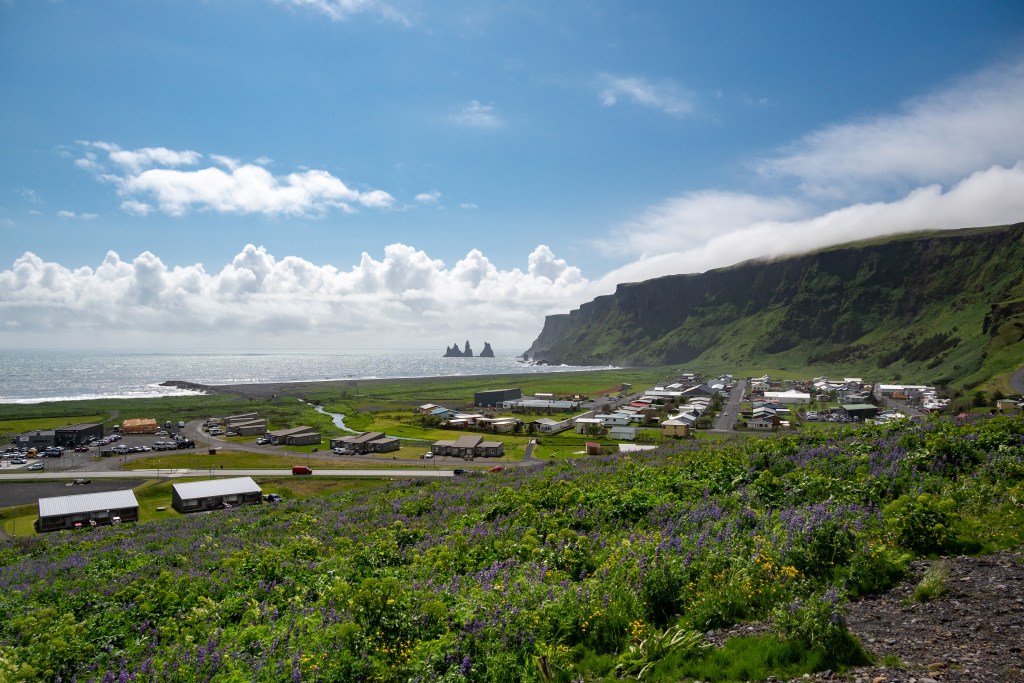
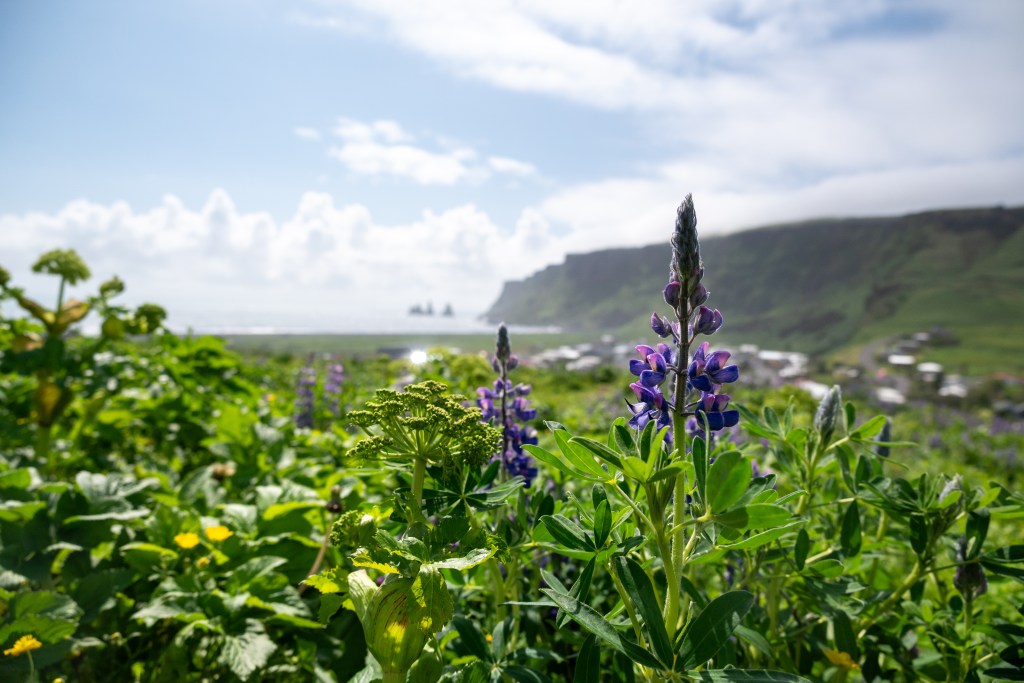
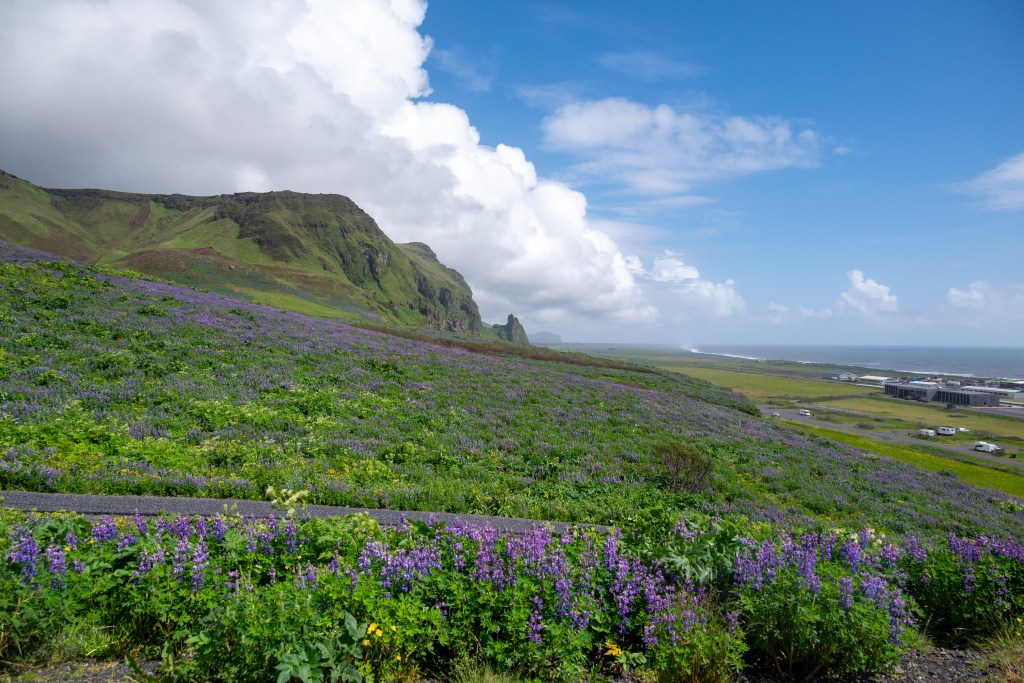
I’ve talked a lot about the lush greenery in Iceland, but I haven’t yet mentioned the flowers. In some areas, the green is accompanied by fields of lupine—a vibrant purple flower.

These flowers are not native to Iceland—this particular kind originated in North America, specifically in the Alaska region. Since they are able to thrive in Alaska’s harsh landscape, they were brought over to Iceland in 1945 to help stop soil erosion. Though, since the plant is able to survive in rough conditions, lupine has spread rapidly throughout the country. Because of this, some people consider lupine an invasive species. While it kind of is, it’s certainly one of the most beautiful invasive species.
Lupine can be seen blanketing Iceland’s landscape from late June to early August. So, I saw the lupine just as it was starting to bloom.
Again, I’m just gonna let the pictures speak for themselves:

Stop #4: Reynisfjara Black Sand Beach
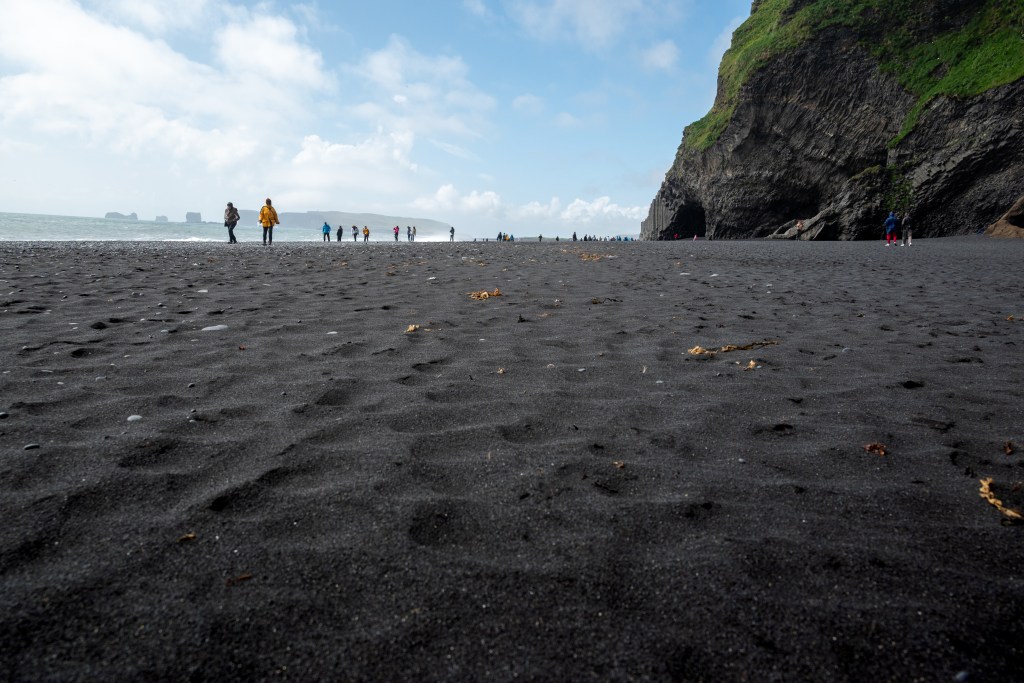
Following Vík, we started heading back west to Iceland’s most iconic black sand beach: Reynisfjara. This is the most famous beach in the country because not only do you get to see the striking black sand, but you also get to see towering hexagonal basalt columns, distant sea stacks, and other unique rock formations.
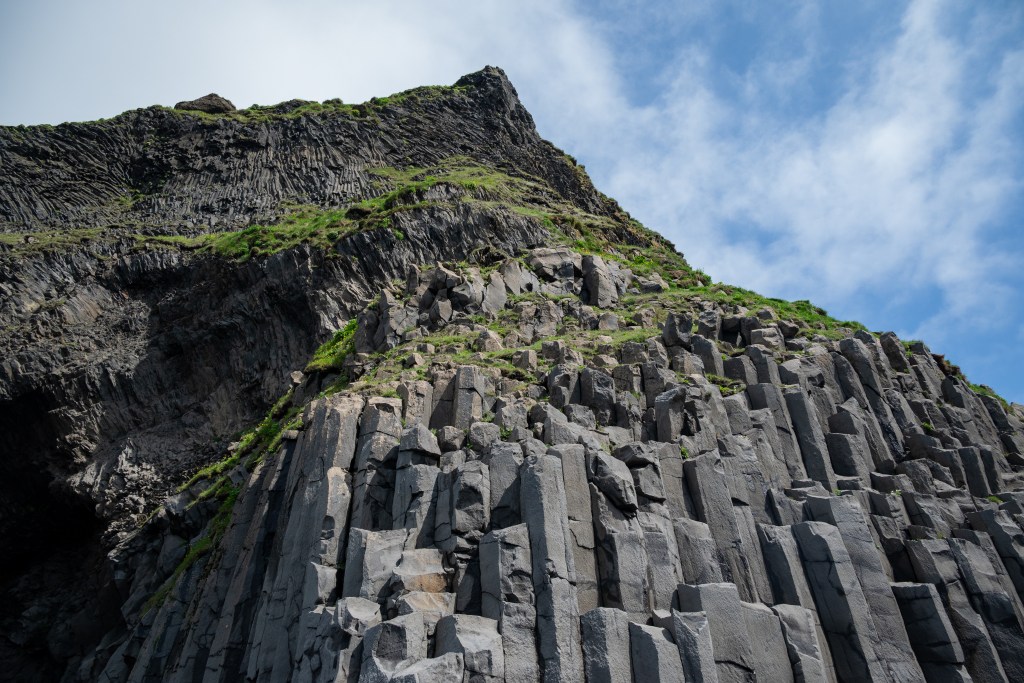
Our guide timed our visit to make sure we would avoid what are known as “sneaker waves”, otherwise known as killer waves. These are huge waves that appear without notice in seemingly calm waters—in other words, they sneak up on you. These waves have claimed multiple lives at this beach, so guides are hyper vigilant to ensure everyone’s safety.
Sneaker waves can appear at any time, but the currents are constantly monitored for the level of danger at the beach at any given time. This wave forecast is then noted at the beach with a green, yellow, or red light. However, the green light is never used. If the chance for sneaker waves is high, the light will be red. Otherwise, it remains at yellow. The light was yellow by the time we visited, but we were still warned about getting anywhere near the water.

We arrived at the beach around at 2:15 and had about 30 minutes here. I started by walking towards the basalt columns. I’d seen hexagonal basalt columns before at Giant’s Causeway in Northern Ireland, however the formations here were very different. There was a section that looked like Giant’s Causeway, however there were also a couple large cavities in the basalt column-hillside. Inside these cavities, some of the columns looked like shale with thousands of splinter-like shards jutting out, threatening to crumble at any moment. Though, the rock was solid and unlikely to fall. Walking into these small caverns was almost like stepping into a different planet for a couple minutes.


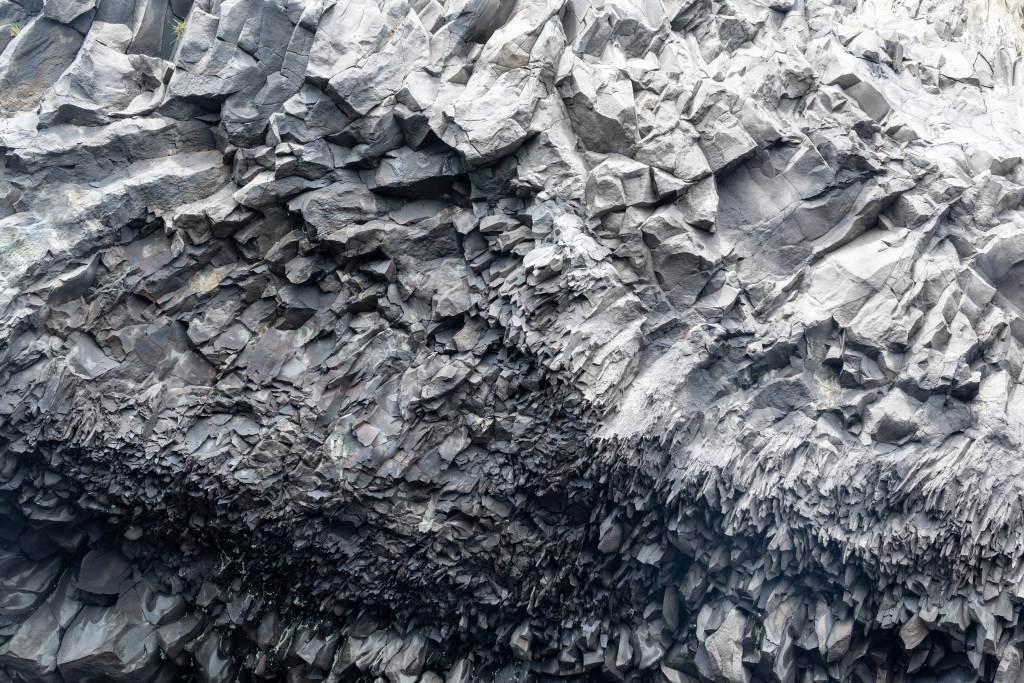

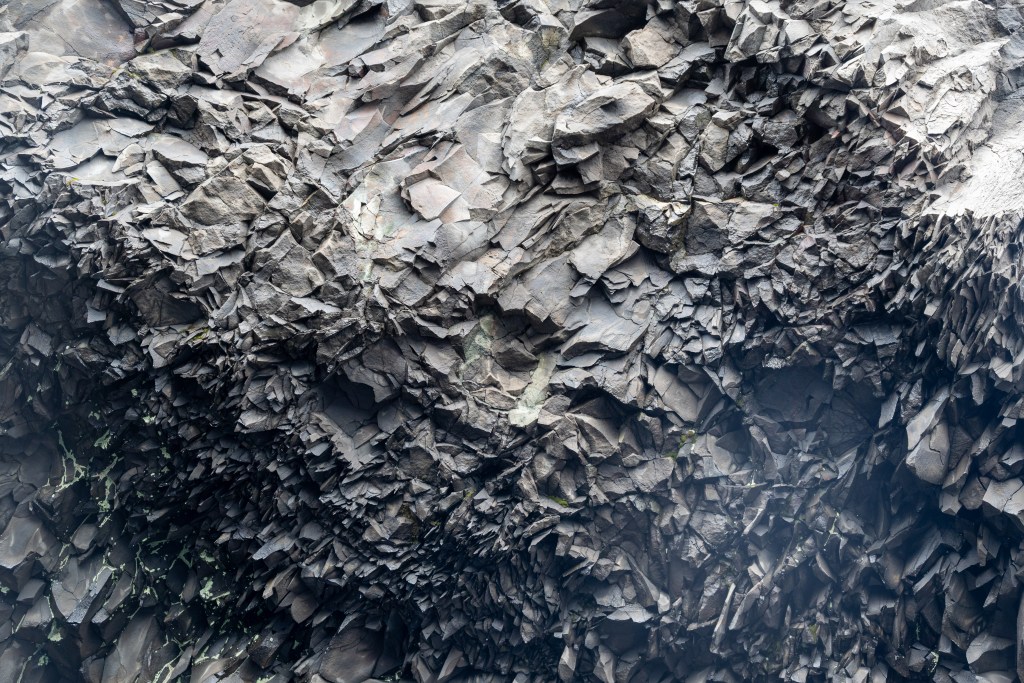


30 minutes at this beach did not feel like enough time. There were a couple sea stacks just offshore past the basalt columns, so I walked to where I could get a good viewpoint of those before hastily treading through the sand back to the bus.

We were told that if there was any place we could see puffins on this tour, this would be the place. Unfortunately, no puffins were sighted. It’s on my bucket list to see puffins in the wild, so obviously now I have to go back until I see one.
Stop #5: Seljalandsfoss
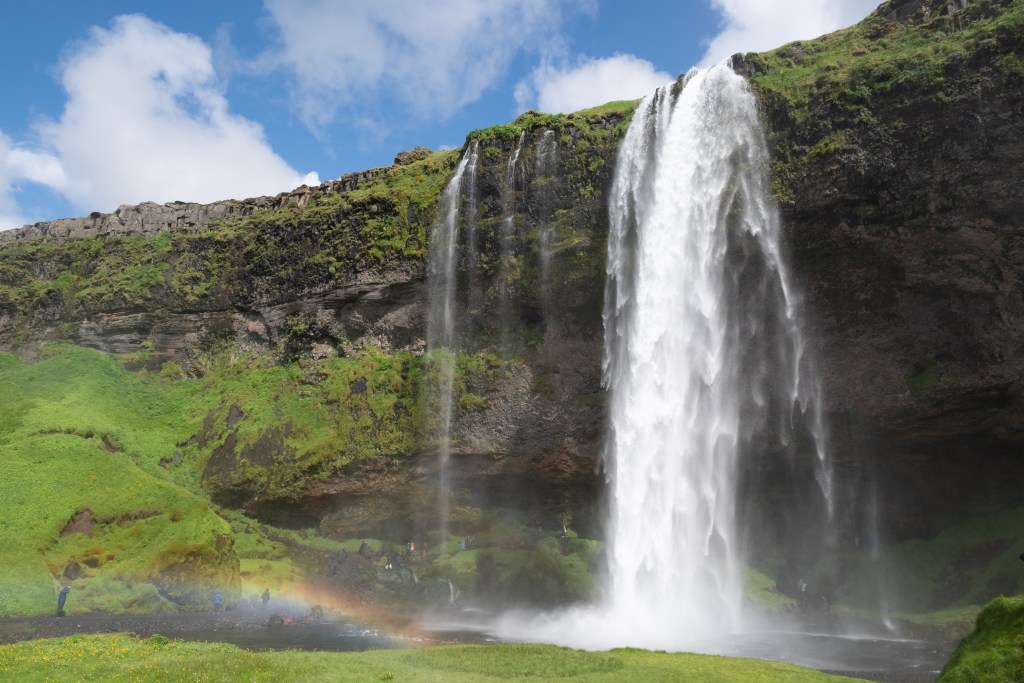
We then carried on through the stunning green landscape to our fifth and final stop: Seljalandsfoss.
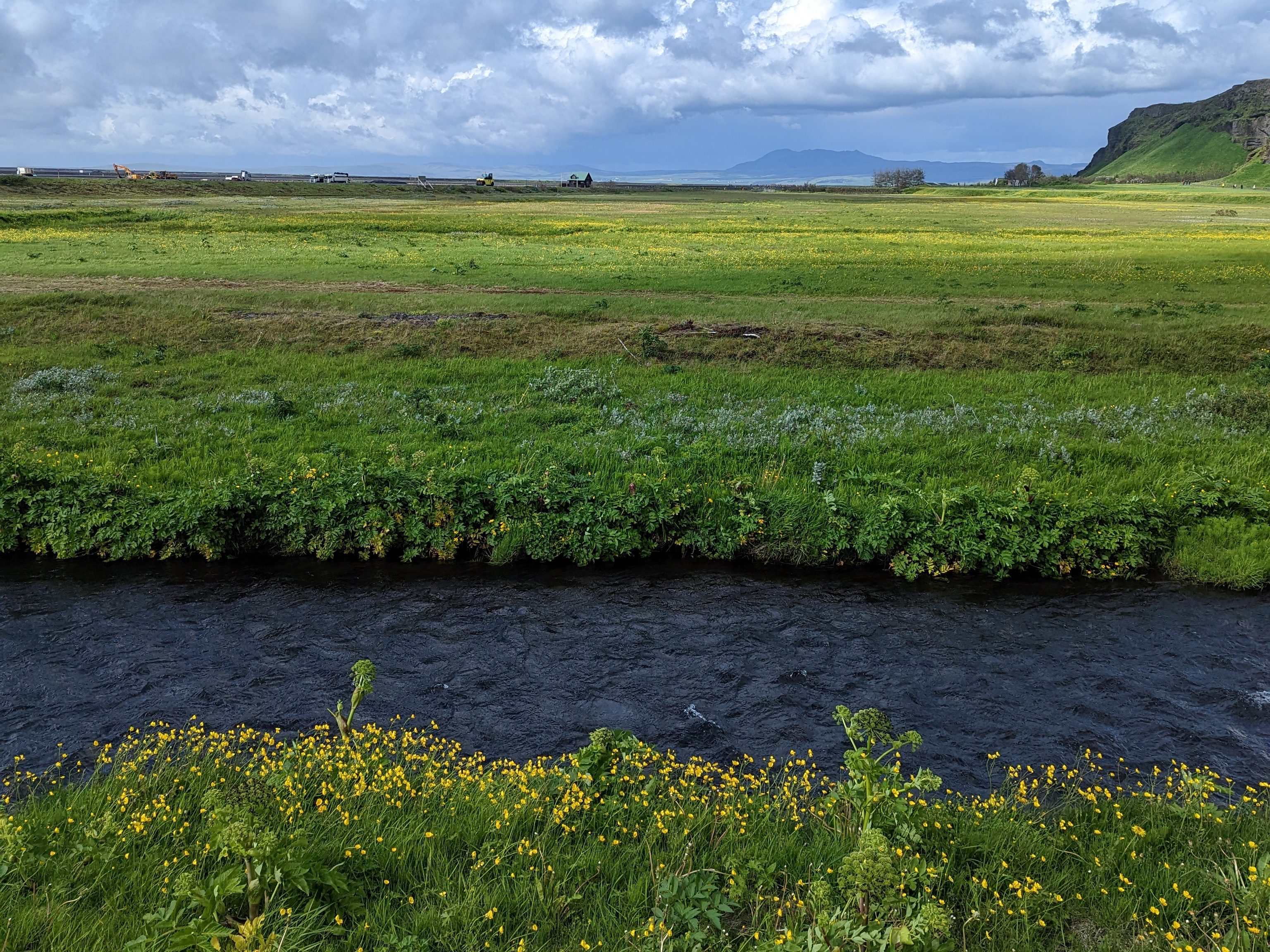
When we drove through this area the first time on our way to Skógafoss, the weather was very gray and hazy, casting a dim shadow on the terrain. However, now it was bright and sunny, and the light practically made the grass a brilliant emerald color. Every time I visit Ireland, I always comment nonstop about how green the grass is, but I think at this moment Iceland topped the greenest grass I’d ever seen. It was extraordinary.

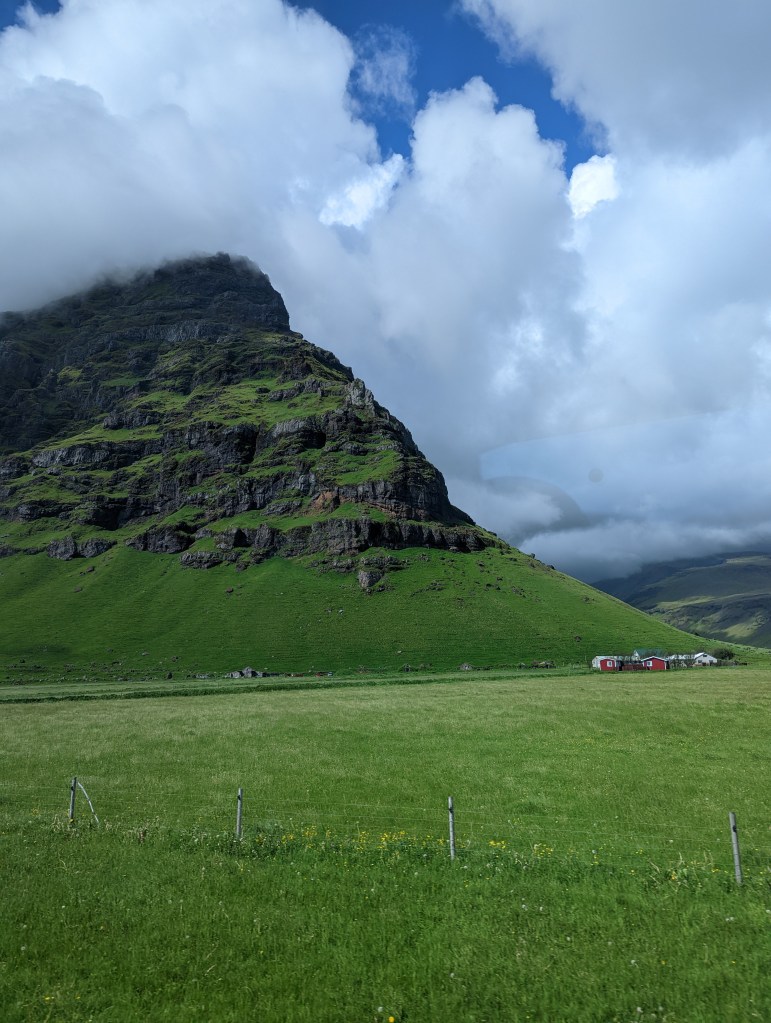
Seljalandsfoss is about the same height as Skógafoss, but it’s a bit thinner. Though, what makes this waterfall so special is you can walk behind it, allowing for a uniquely immersive experience.
Just standing in front of the waterfall from a distance was a beautiful sight. The foreground was painted with rich hues of green and speckled with yellow dandelions, while the white cascade popped brightly against the dark rocky backdrop. But I wasn’t prepared for the sight I was about to see closer to the waterfall.

As I walked to the side of the waterfall, the sunlight caught the droplets of ethereal mist dispersing from the white veil of falling water and formed a small—but incredibly vibrant—rainbow. It was an unforgettable spectacle.
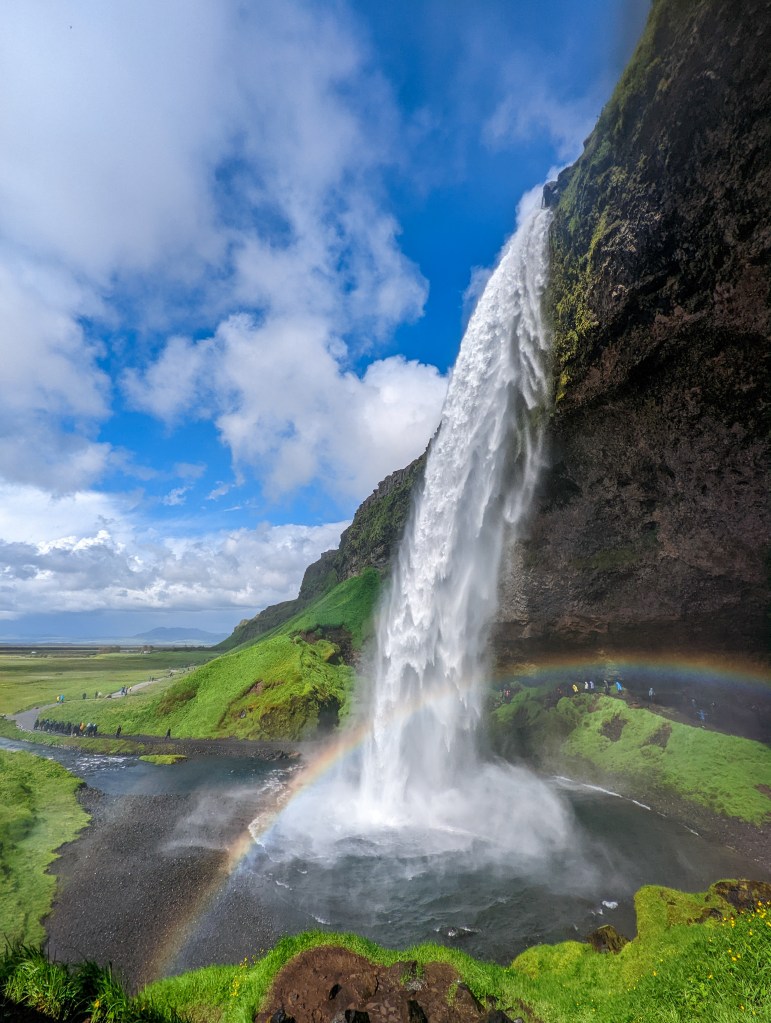
I continued venturing behind the curtain of water which gave way to a hidden world. The glistening, moss-covered rock walls curved above our heads, creating a cavernous sanctuary carved into the cliffside.
The swirling mist didn’t look like much from afar, but up close I got drenched, and the narrow path around the base of the waterfall was slick from the water. You definitely need a raincoat and hiking boots here.
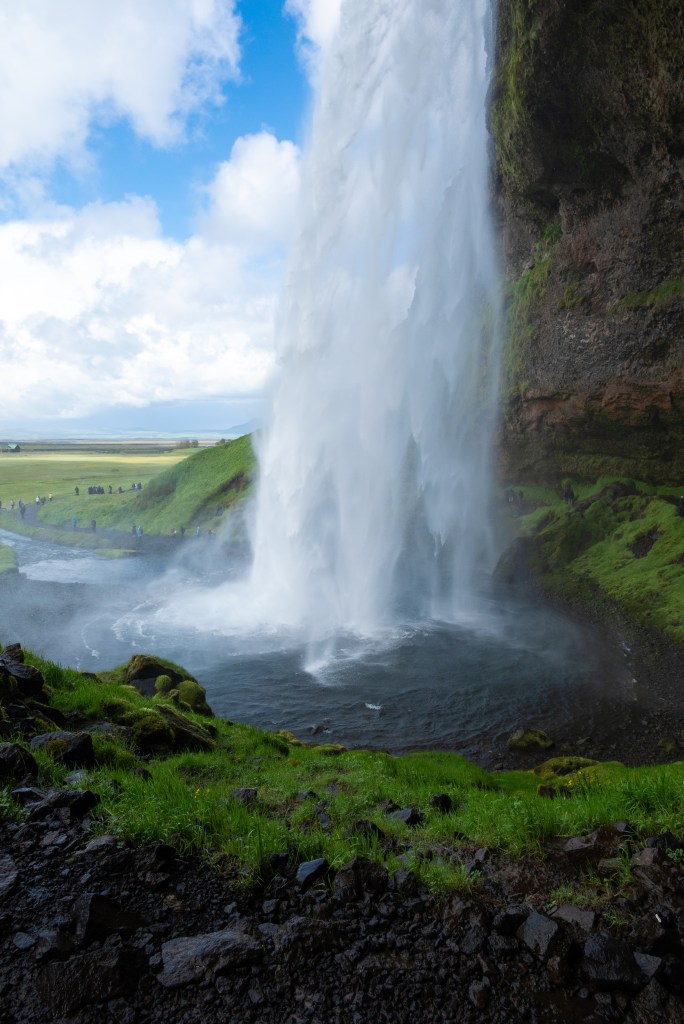


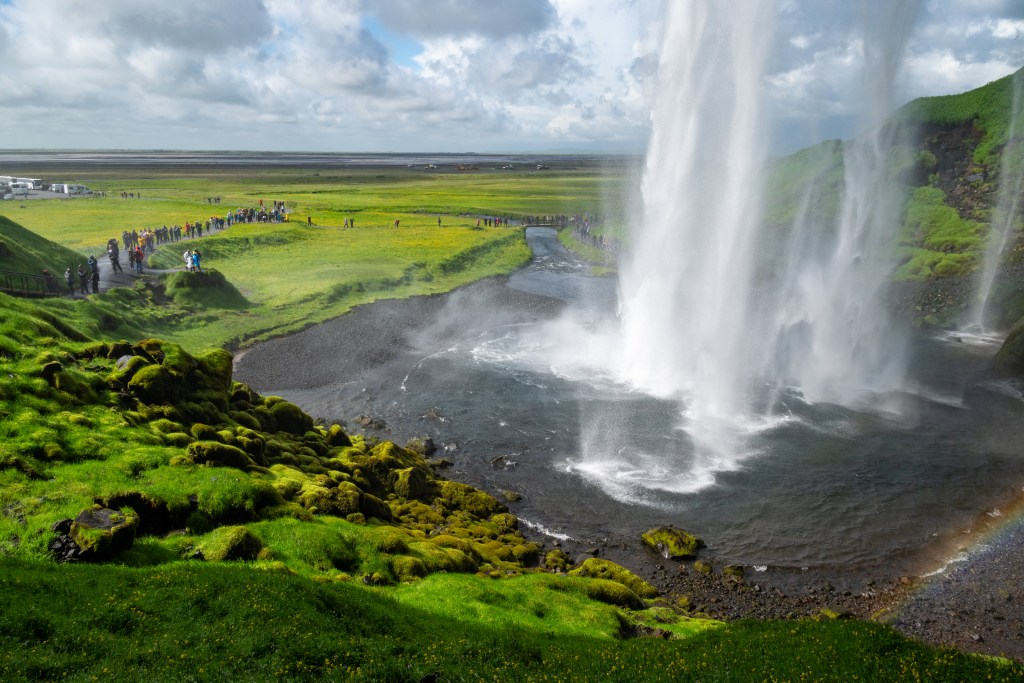
Before my journey around the waterfall came to a conclusion, an unexpected gust of wind sent a shower of mist in my direction, thoroughly soaking my hair. Yet, I couldn’t have felt more euphoric in that moment. I was beaming from the natural beauty of it all. Despite the thunderous white noise that echoed on the walls, the cascade seemed to plunge gracefully. Rays of sunlight danced through the vapor, and I felt refreshed as the cool mist clung to my clothes and hair. I couldn’t stop grinning.

I eventually—slowly—made my way back towards the bus. We spent 30 minutes here, and somehow it felt much longer than the 30 minutes we had at Skógafoss. It was almost as if I had been temporarily transported to another realm.
Our guide was standing beside the small rippling stream that flowed from the waterfall and told us that the water here is safe to drink. In fact, apparently it’s safe to drink from most streams and rivers here. I’m very fortunate to live in Chicago where we have access to a huge freshwater lake, but that water is not safe to drink without it being processed first. In Iceland, many river systems come from the glaciers and there’s little pollution to contaminate the water. The water that creates Seljalandsfoss specifically originates from the Eyjafjallajökull glacier, which then feeds into the Seljalandsá River.
While I got a little plant debris in my water, it was incredibly clear and tasted super fresh and clean. I tried to savor the water in my water bottle until I had to go to the airport the next day.
To sum all of this section up, Seljalandsfoss was probably my favorite stop on the tour.
My new favorite hobby is getting drenched in waterfalls.
(p.s. I briefly used ChatGPT for wording inspiration to describe the scene. I didn’t copy any of the sentences, though I would like to at least acknowledge it for this unused gem:
“The sunlight refracted through the droplets, creating a vibrant spectrum of colors. It was as if I had stepped into a living, breathing painting, each droplet holding a secret dance of light.”)
Back to Reykjavík
And thus concluded our day’s journey to the southwest coast of Iceland. We took the same route back to Reykjavík, so we had the chance to see the side of the road we weren’t able to see on the way there, which was a treat.
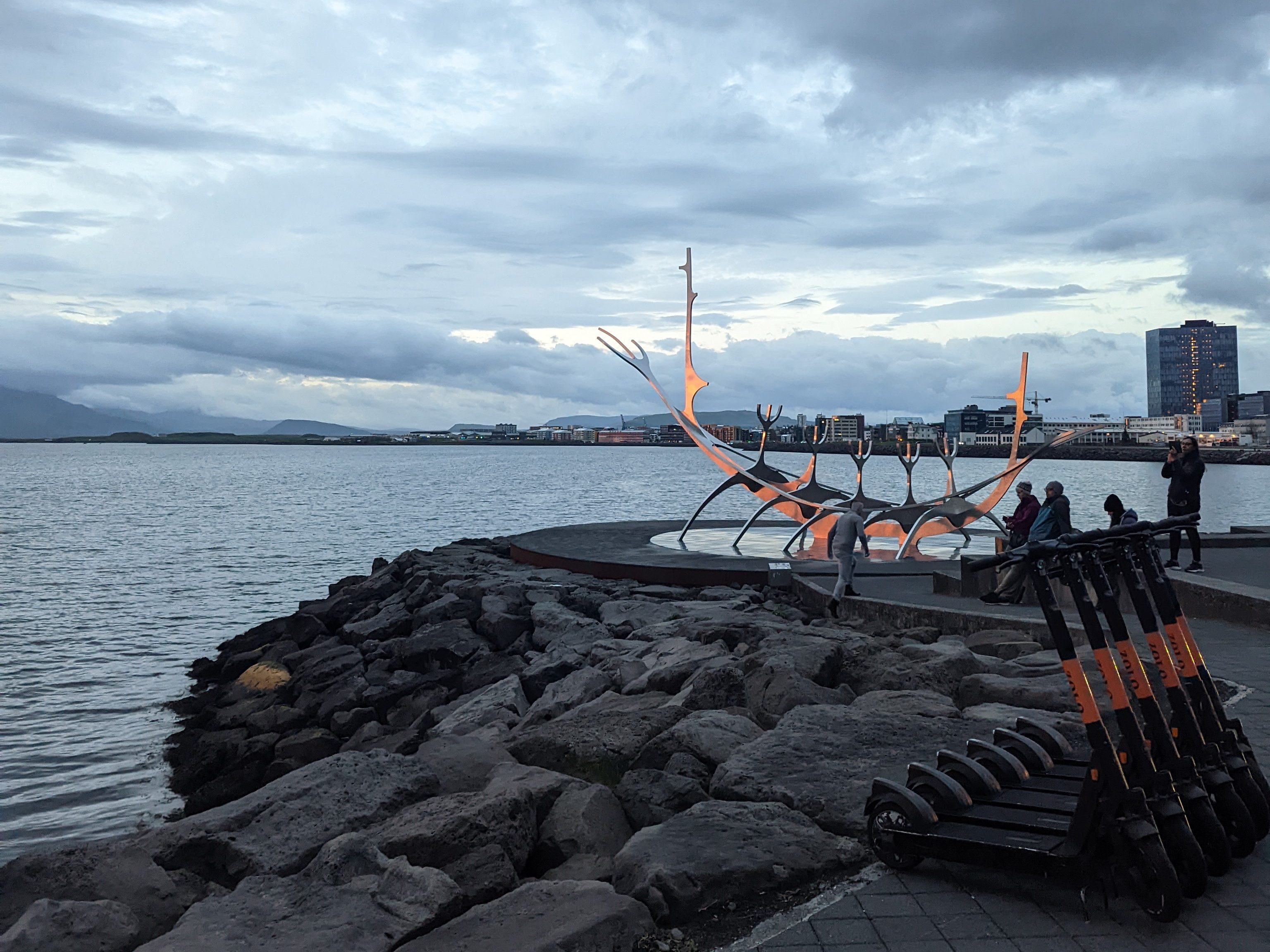
We got back to Reykjavík by about 6 p.m., but before I went back to my hostel, I stopped by the bay and the Sun Voyager sculpture. The view was somehow even clearer than it was in the morning and I could see even more previously-hidden hills and valleys in the distance.

I eventually went back to my hostel for a little while to freshen up before venturing outside again to find some dinner. I ended up getting a pre-made pasta meal from Bónus and ate it by the water. It was one of the most scenic and relaxing dinners I’ve had, and I couldn’t get over how voluminous the clouds looked all day.

I went back to my hostel again around 7:30 and occupied myself until the sun started setting—which wasn’t until 11 p.m. While a bit overcast, the weather was immensely calmer and clearer than the day before. This was finally my chance to see the midnight sun.
Midnight Sun
I left my hostel around 11:10 and was greeted with golden hour. Truthfully, the setting sun looked like any other ordinary sunset, but with the knowledge that it was nearing the middle of the night, the air felt magical. I’ll let this screenshot of me tell you how I was feeling in this moment:

As I admired the view, I tried scoping out the best spot to watch the sun sink below the horizon. I walked past the Sun Voyager again, which was now glowing from the orange hues of the sun. To my dismay, clouds started rolling in and blurring the line between the water and the sky. Though, this didn’t disrupt the views too badly in the end.

I continued walking for about 10 minutes down to the Harpa Concert Hall (which is a gorgeous glass building) and decided to sit by the harbor there for a little while. This was an excellent spot, mainly because there was a glass panel that perfectly reflected the sky, creating a stunning mirrored image.

Though, to watch the sun officially set, I decided to find some place a little closer to my hostel—not because I felt unsafe (walking around in Iceland was the safest I’ve ever felt)—but because it was getting colder and windier as the light got dimmer and dimmer. So, I opted for a seat on the rocks near the Sun Voyager and awaited the official time of sunset: 12:03 a.m.


I was anxious to take my eyes off of the scene in front of me—the sunset changed every second. I watched as the sky shifted through different hues of vibrant oranges and yellows. The clouds, illuminated by the glow of the sun, were slowly moving across the sky, allowing new beams of light to emerge and shine towards the heavens. I was thoroughly encapsulated in the moment. It was a surreal feeling.
The sun finally set, though an orange glow remained above the horizon and the clouds that mercifully held off from covering the sky until the sun disappeared. The sky was still incredibly light as I walked back to the hostel.


I was exhausted from the long day, and as soon as I got back to my room, I settled into my bunk bed for some much-needed rest.
And that was the end of one of the best days of my life.
Day 3: Relaxing in Reykjavík
The next morning I woke up around 9ish. My flight wasn’t until the evening, but I had to check out of my room, so I packed up my things and left my luggage with the hostel until I had to leave.
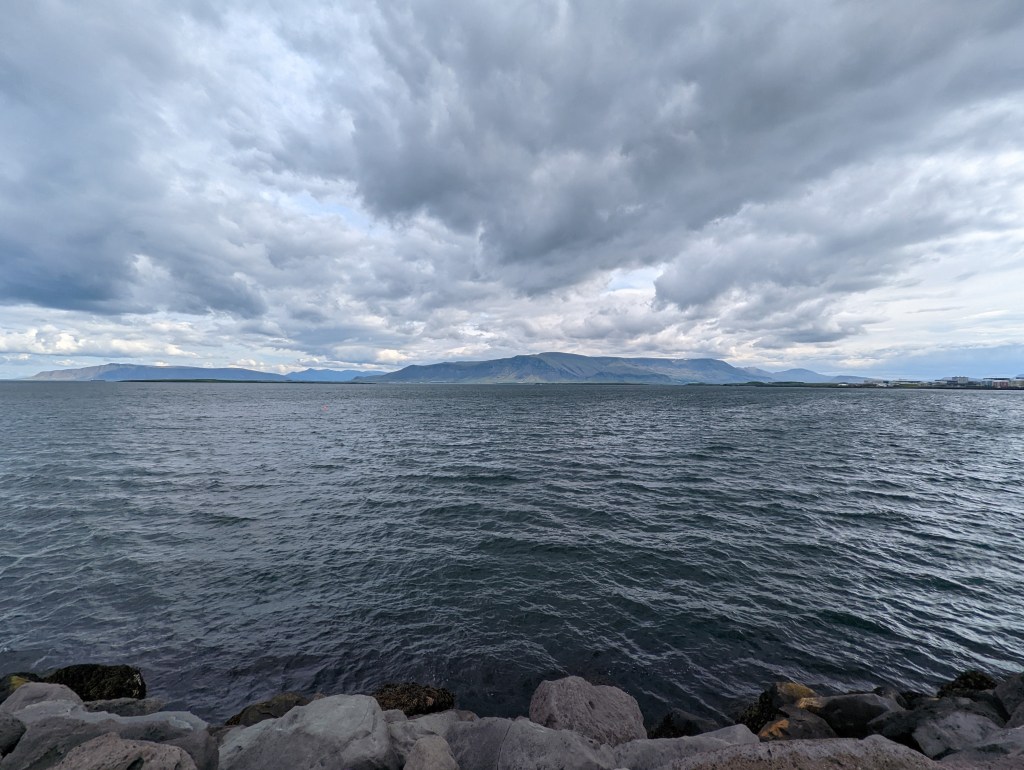
I was quite thankful for the late flight, allowing me an entire morning and early afternoon to explore Reykjavík. The day started out cloudier than the day before, but the bay was clear of haze and the distance mountains were visible.
Since I hadn’t dined out at all in Iceland, I decided I would treat myself for my last meal there. I found a café on Google that was pretty close to the hostel called Kaffibrennslan. I ordered my meal and chose to sit upstairs, which I had completely to myself.


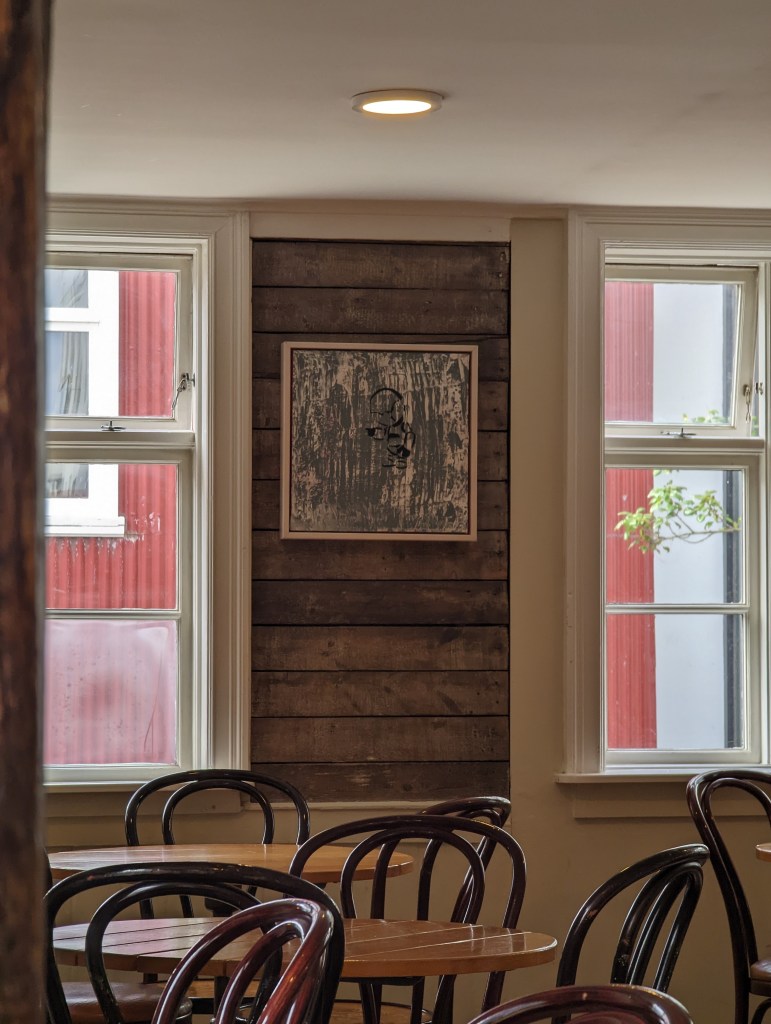
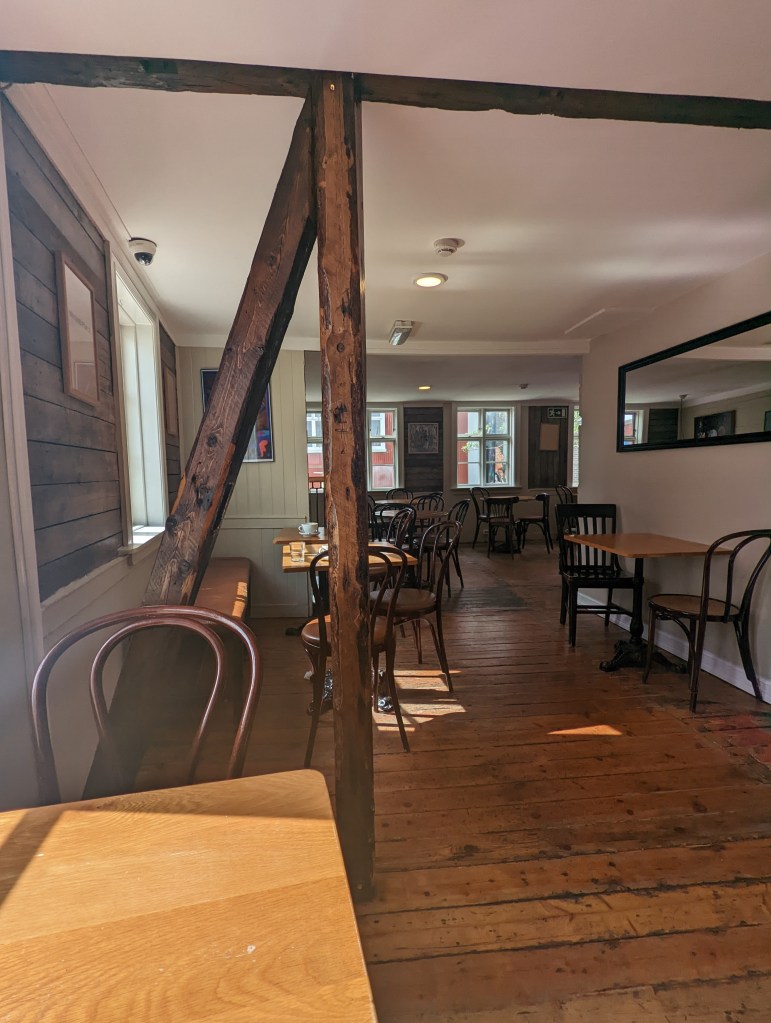
As I waited for my food, I relished in the quietness of the rustic room. I sat at a table by an open window that was illuminated by emerging beams of sunlight. The quaint interior combined with the cool breeze from the cracked window and the warmth of the sunlight on my face made for a perfect moment.


My chai latte arrived first. I’d never had a drink with latte art (other than the bear latte art I got in Thailand), and it looked so picture-perfect when paired with the environment. It was delicious, too. I tried saving most of it until my equally delicious banana pancakes arrived. I savored the meal and the moment, trying to make my last few hours in Iceland last (though, when I say savored, I really mean I devoured those waffles).


The latte and waffles ended up being a little under $20. Yeah, that’s a little expensive for a small cafe breakfast when compared to American prices, but I’d heard of people paying $30+ on a simple meal here, so I was satisfied.
After I finished my meal, I wandered around downtown Reykjavík, this time exploring areas that were farther away from the hostel now that it wasn’t pouring rain like the first day.
I’d seen an art installation on Google Maps called Þúfa (pronounced Thufa) that I wanted to check out, so I went on a mission to find it. I had a heck of a time trying to get to it. I walked along harbors and kept running into dead ends, forcing me to turn around and find a new route. Looking back now, I was using Google Maps to try navigating as if it were a real map with no directional aid abilities, and I’m not sure why I didn’t use the app to just show me the route.

Eventually I found myself on another pier and was walking through parking and shipping lots that I wasn’t sure I was allowed to be in. But, after probably about 30 minutes of walking, I finally found Þúfa.

Þúfa is a small hill with a spiral pathway leading to the top where a small wooden stall sits. The main reason I wanted to visit this is because I was really curious about what it was, though there weren’t any signs I could find that described its purpose. What I found at the top was not what I expected to see even in the slightest—inside the wooden shed were dead fish hanging to dry. It took me a moment to realize what they were, but once I did, I was confused and honestly a little grossed out.


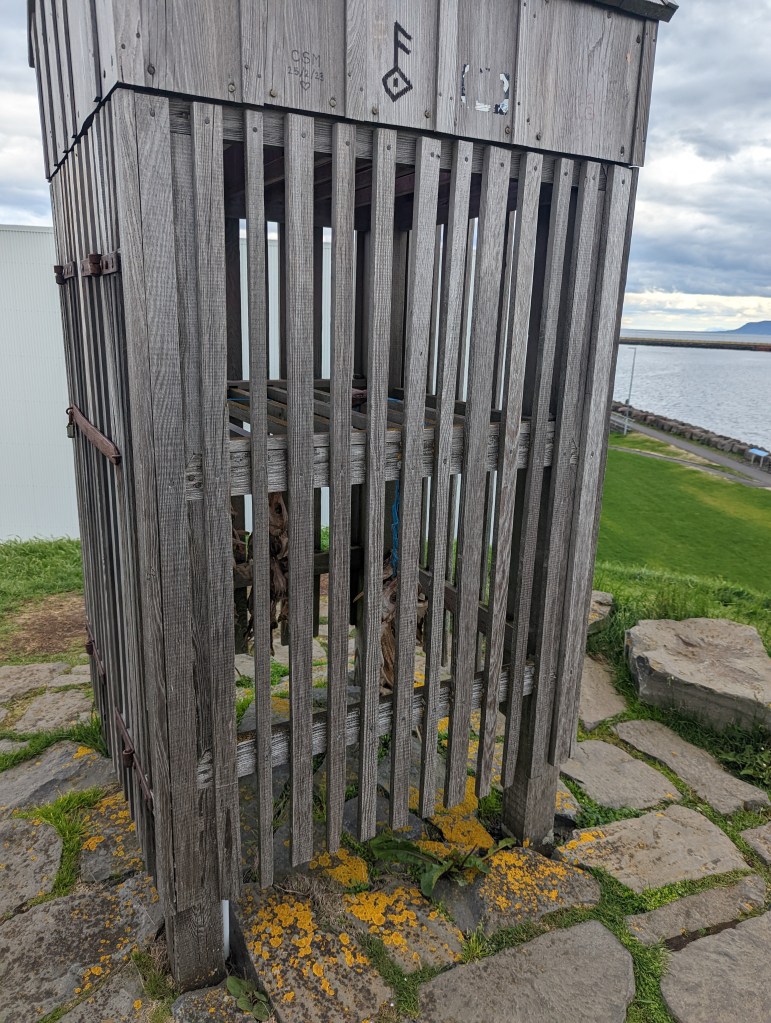
Upon further research, it turns out this type of shed has been used for drying fish for centuries for traditional Icelandic dishes. I just wasn’t mentally prepared to see decaying fish after that lovely morning meal.
Despite the unexpected finding, from the hill you can see Reykjavík’s skyline, which is very small compared to what most would consider to be a major city skyline. It’s truly a breath of fresh air—both metaphorically and literally.

I still had quite a bit of time until I had to leave for the airport, but I hadn’t realized I’d walked nearly 45 minutes away from the hostel. So, I slowly started making my way back to towards the main shopping area I’d explored the first day. Along the way I happened upon interesting historical sites and perused a few more shops.
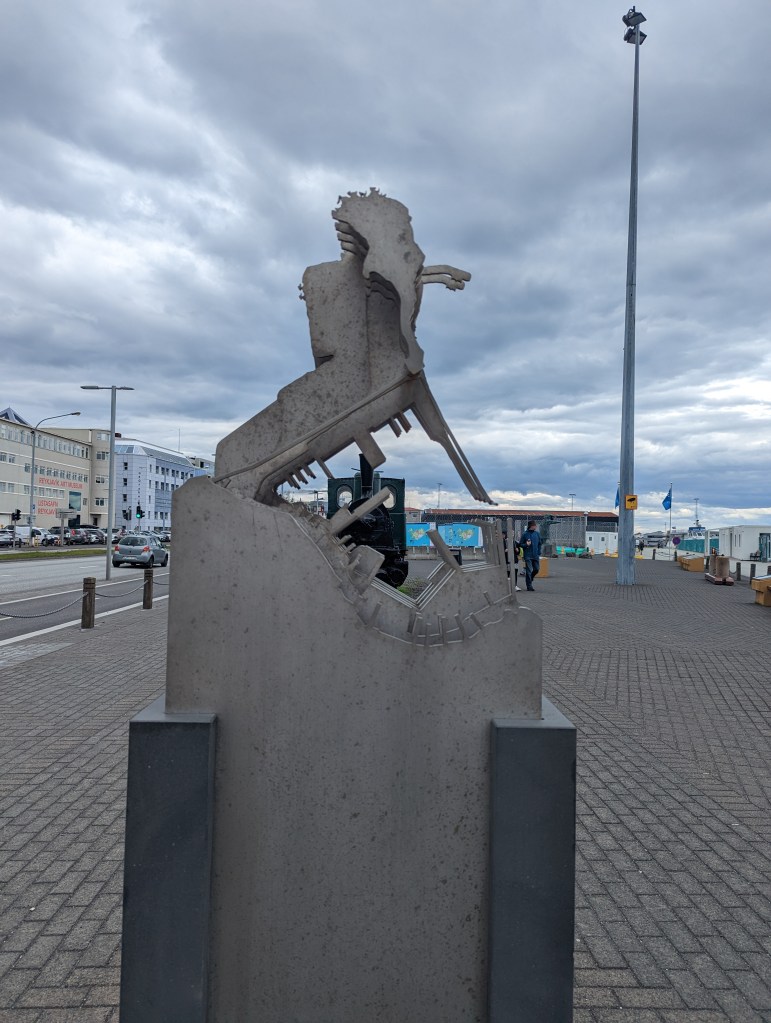

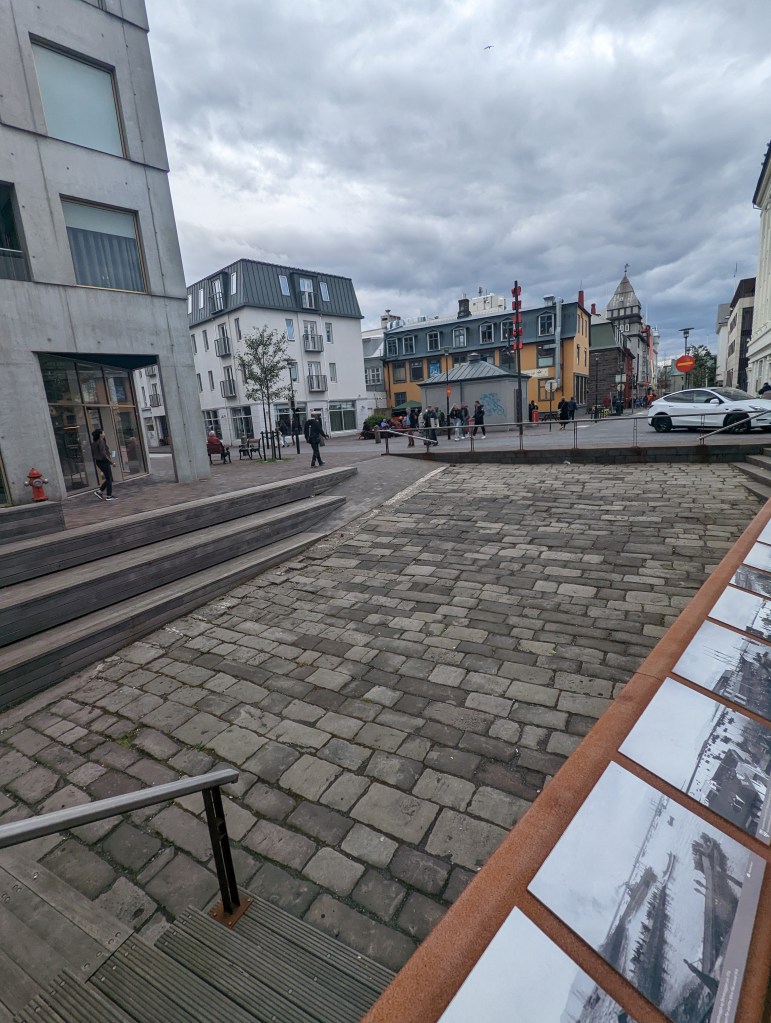

Also, I couldn’t leave Iceland without buying a few more snacks from Bónus. I had to get more of that chocolatey granola snack I mentioned earlier because I ate it all the day before.
I still had some time before my bus arrived, so I sat on the rocks by the bay and savored the view.
But eventually, I couldn’t savor the moment any longer—it was time to head to the airport. I’d booked another bus ticket online in advance through the same service I got to Reykjavík with. I got my luggage and waited outside of the hostel for the bus to arrive around 3 p.m. After worrying for a few minutes that it wasn’t going to show up, it eventually did and I enjoyed a relaxing 45-minute ride through the rolling landscape once more.
My flight didn’t leave until about 7:30 p.m. and I got to the airport around 4:30. The airport is quite small and very quiet, so it didn’t take me long to get through security. I walked around for a bit and saw this photo of Seljalandsfoss and imagined I was back there instead of awaiting a flight home:

I found a place to sit and snacked on some of the things I bought from Bónus.
About an hour before boarding, someone announced they were looking for a passenger on the Chicago flight to stay an extra night because the flight was overbooked, and they were offering free accommodation and 400 euros. I so would’ve taken the offer if I didn’t have to pack my entire apartment and move in three days. So alas, I had to pass.
By the time we boarded and left, it was raining again. I had a window seat, and while we ascended I watched as the rough, dark green landscape of Iceland disappeared behind us into the hazy mist.

In Conclusion
Despite being in the country for less than 48 hours, Iceland greatly exceeded my expectations. I had high expectations to begin with, so that really says a lot.
I had just come from Scotland where I’d been in the lush green Highlands for a few days. Some people compare the Highlands to Iceland to determine which is “better”, and while they’re both stunning, they are impossible to compare. Scotland does have some dramatic sights, but much of the Highlands are very hilly. Iceland on the other hand has dramatic mountains and cliffs which are all made of volcanic rock, making the deep green really pop in contrast to the dark rock and soil beneath, as I’ve mentioned many times throughout this experience.
I really wish I’d had more time in Iceland, but I’m incredibly glad I went even for the short 48 hours. The trip to the south coast was truly one of the best days of my life, and we lucked out by having gorgeous weather. Next on my bucket list is to spend a week+ there and drive around the entire coastline. I’d also love to return to see the Northern Lights in the winter, though—despite being from Northern Michigan—I’m not sure if I’d be willing to tolerate the snowy, blustery weather. Perhaps someday.
This year I’ve been thinking a lot about how I haven’t been pursuing what I really want to do with my life. I quit my salaried 9 to 5 job a couple weeks before this trip to start working as a tour guide in Chicago, but I was still antsy about not “going after my dreams”, whatever those may be. I’m constantly thinking about the future and how it’s going to turn out. I’m never in the present.
There was a moment when I first got to Iceland when these thoughts started creeping into my mind again, but then I suddenly remembered: “Oh wait, I’m in Iceland. I’m literally doing the exact thing I want to do in life,” that thing being travelling and seeing the beauty of the world. I was suddenly so content and at peace with the present moment.
TL;DR: I loved Iceland.
 Happy Lil’ Traveller
Leave a comment